
SEOGuide
List of Search Engines and Where Each One Is Used
Google handles about 85% of US searches, but it isn't the leader everywhere. Here's who runs each major search engine, where it's popular, where it's rare, and which ones a US business should care about.

By Akif Qureshi
Published 10 min read
On this page
This list of search engines covers 13 search engines worth knowing, from Google and Bing to Yandex, Baidu and Naver, with who runs each one, where its results come from, where it's popular and where almost nobody uses it.
The short version for US readers: Google handles about 85% of searches in the United States, and Bing, Yahoo and DuckDuckGo split most of the rest. Engines like Yandex, Baidu and Naver are giants in their home countries but barely register here. All market share figures below are from StatCounter for October 2026, and the company facts were checked against the companies' own pages and other primary sources on November 17, 2026.
Key takeaways
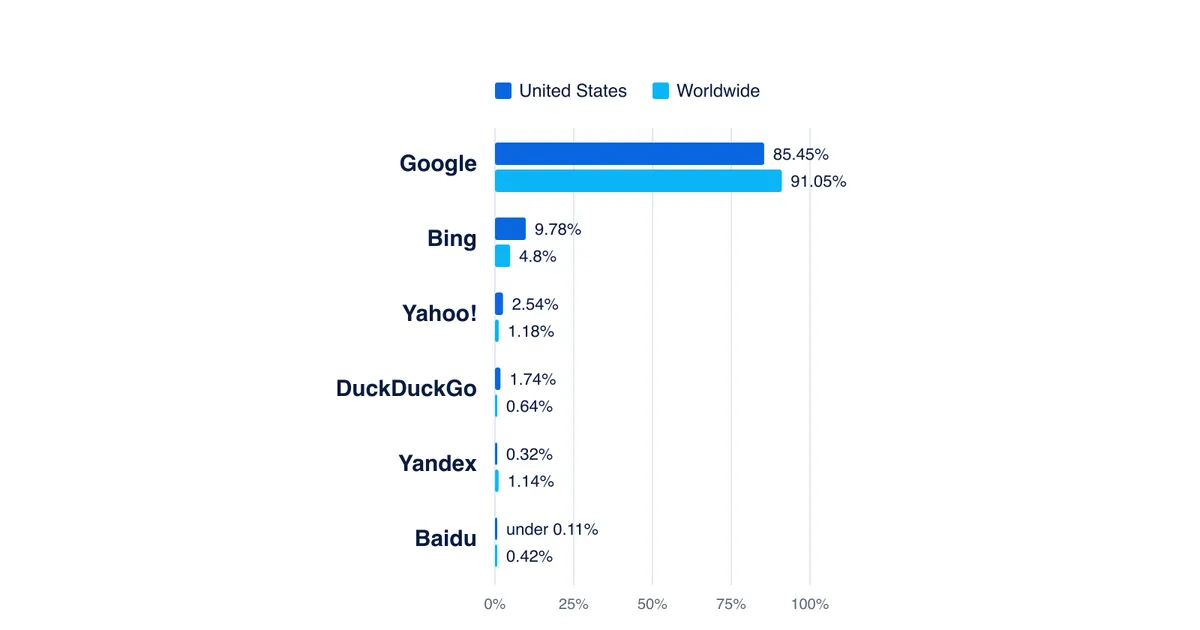
Search engine market share: US vs. worldwide
StatCounter estimates search share from the visits search engines send to the websites that use its tracking code, so treat these as good estimates, not a census.
| Search engine | United States | Worldwide |
|---|---|---|
| 85.45% | 91.05% | |
| Bing | 9.78% | 4.8% |
| Yahoo | 2.54% | 1.18% |
| DuckDuckGo | 1.74% | 0.64% |
| Yandex | 0.32% | 1.14% |
| Baidu | under 0.11% | 0.42% |
| Ecosia | 0.11% | not in the top 6 |
Source: StatCounter Global Stats, United States and Worldwide, October 2026, accessed November 17, 2026. StatCounter lists the top six engines for each region; Baidu doesn't make the US top six, so its US share is below Ecosia's 0.11%.
Two things stand out. Bing's US share is about twice its worldwide share. And Brave Search, Startpage and Dogpile don't appear at all: StatCounter groups them under "other," which means each has under 0.11% of US searches by this measure.
The list: 13 search engines and where they're used
1. Google
- Run by: Google, part of Alphabet (US).
- Used most: almost everywhere. Google has 85.45% of US searches and 91.05% worldwide.
- Used rarely: China, where it has 6.83% in StatCounter's data. In Russia it's second to Yandex at 28.36%, and in South Korea it's only narrowly ahead of Naver.
Google is the default search engine for most Americans, and for most US businesses it's where nearly all organic search traffic comes from. That's why Google Search Console is the first tool to set up and why Google's core updates move traffic so much.
2. Bing
- Run by: Microsoft (US).
- Used most: the US (9.78%) and other English-speaking markets, especially on Windows PCs, where Microsoft's Edge browser uses it by default.
- Used rarely: Russia (0.82%).
Bing is bigger than its own share. It provides Yahoo's web results, most of DuckDuckGo's traditional links, part of Startpage's results, and part of ChatGPT's web search. Bing Webmaster Tools is free, and Bing supports IndexNow, which lets you tell search engines about new or updated pages right away.
3. Yahoo
- Run by: Yahoo (US). Results powered by Bing.
- Used most: the US, where it's the third-largest engine at 2.54%.
- Used rarely: most other markets (1.18% worldwide).
Yahoo stopped running its own web index years ago. Microsoft and Yahoo agreed in 2009 that Bing would power Yahoo Search, and Yahoo's results pages still carry a "Powered by Bing" label (checked November 17, 2026). If you rank on Bing, you'll usually rank on Yahoo too.
4. DuckDuckGo
- Run by: DuckDuckGo (US).
- Used most: privacy-minded users; of the markets we checked, its biggest share is the US (1.74%).
- Used rarely: Russia (0.18%).
DuckDuckGo doesn't build search histories or profile users. Its help page on where its results come from says its traditional links and images are "largely" sourced from Bing, alongside its own crawler (DuckDuckBot) and specialized sources such as Wikipedia for instant answers. So Bing visibility carries over here as well.
5. Brave Search
- Run by: Brave Software (US), the company behind the Brave browser.
- Used most: Brave browser users, plus AI tools that use its search API.
- Used rarely: in StatCounter's data it doesn't appear in any top six, so its share of human searches is small everywhere.
Brave Search is unusual: Brave says it runs on "a completely independent index of the Web" and calls itself one of only three global-scale search engines in the West. Its bigger impact may be behind the scenes. Its API is one of the main sources for Claude's web search, so pages Brave can crawl have a better chance of showing up in AI answers.
6. Startpage
- Run by: Startpage, based in the Netherlands and part of System1's group of brands.
- Used most: privacy-focused users who want Google-style results without being tracked.
- Used rarely: it doesn't appear in StatCounter's top six for any market we checked.
Startpage launched what it calls the world's first private search engine in 2006. It doesn't run its own index: its support center says it gets its results from Google and Microsoft Bing, without passing your personal data to them.
7. Dogpile
- Run by: System1 (US), which lists Dogpile among its consumer brands.
- Used most: a small US audience.
- Used rarely: everywhere; it's grouped under "other" in StatCounter.
Dogpile is a metasearch engine: it doesn't crawl the web, it combines results from other search engines into one page. There's nothing to optimize for directly; if you rank on the engines it pulls from, you'll show up here too.
8. YouTube
- Run by: Google.
- Used most: worldwide, including the US, for how-to, product review and entertainment searches.
- Used rarely: StatCounter doesn't count YouTube as a search engine, so there's no comparable share.
YouTube isn't a web search engine, and StatCounter doesn't count it as one, but its search box is where many people start when they want to see something done: fixing a leaky faucet, setting up a Shopify store, comparing two phones. If your audience watches before it buys, YouTube search deserves its own plan: clear titles, descriptions that use the words people search, and chapters.
9. Yandex
- Run by: Yandex (Russia).
- Used most: Russia, with 70.22% of searches, and other Russian-speaking markets.
- Used rarely: the US (0.32%) and most of Western Europe.
Yandex is the clear leader in Russia. Its ownership changed in 2024: Yandex N.V., the Dutch parent company, sold all of its Russia-based businesses to a Russian buyer group for about $5.4 billion, and the Dutch company now operates as Nebius. Yandex has its own Webmaster tools and supports IndexNow.
10. Baidu
- Run by: Baidu (China).
- Used most: mainland China, where it had 49% of searches in StatCounter's China data.
- Used rarely: outside China (0.42% worldwide, under 0.11% in the US).
Baidu is a Chinese-language search engine with its own webmaster platform, the Baidu Search Resource Platform. Treat StatCounter's China numbers as a rough guide: the same data shows Yandex at 11.77% there, which says more about which sites carry the tracker than about real habits. Baidu only matters for US businesses that actively sell into China with Chinese-language pages.
11. Naver
- Run by: Naver (South Korea).
- Used most: South Korea, where it had 42.25% of searches against Google's 48.48% in StatCounter's South Korea data.
- Used rarely: outside Korea.
Naver is South Korea's homegrown portal and search engine. It has its own webmaster tool, Naver Search Advisor, and supports IndexNow. If you sell to Korean consumers, including Korean-speaking communities in the US, Naver is worth a look; otherwise you can skip it.
12. Rambler
- Run by: Rambler (Russia).
- Used most: Russia, though even there its search share is tiny.
- Used rarely: everywhere, including Russia, where it had 0.04% of searches in StatCounter's Russia data.
Rambler was one of Russia's early search engines, but since 2011 its search has run on Yandex's technology. Optimizing for Yandex covers it.
13. VK
- Run by: VK (Russia), the company formerly known as Mail.ru Group.
- Used most: Russia. VK says its social network reaches over 100 million people a month, and the company also runs the OK social network and Mail.ru email.
- Used rarely: the US and Western Europe.
VK is a social network, not a web search engine, though people use its search to find people, groups and videos. Mail.ru search, from the same company, had 0.3% of Russian searches in October 2026. For US businesses it's only relevant if you market to Russian speakers, and the sanctions note below applies.
Search engines at a glance
| Search engine | Based in | Results come from | Used most | Rarely used |
|---|---|---|---|---|
| US | Own index | US and worldwide | China | |
| Bing | US | Own index | US, Windows users | Russia |
| Yahoo | US | Bing | US | Most other markets |
| DuckDuckGo | US | Mostly Bing, plus its own sources | US and Europe, privacy users | Asia, Russia |
| Brave Search | US | Own index | Brave browser users, AI tools | Small everywhere |
| Startpage | Netherlands | Google and Bing | Europe, privacy users | Most markets |
| Dogpile | US | Other engines (metasearch) | Small US audience | Everywhere |
| YouTube | US | Own video index | Worldwide | China |
| Yandex | Russia | Own index | Russia | US, Western Europe |
| Baidu | China | Own index | China | Outside China |
| Naver | South Korea | Own index and content | South Korea | Outside Korea |
| Rambler | Russia | Yandex | Older Russian users | Everywhere |
| VK | Russia | Social network search | Russia | US, Western Europe |
Not search engines: Amazon, Pinterest, Facebook and the rest
Lists like this often mix in big sites that people search on but that aren't search engines:
- Amazon: where many Americans start shopping searches. Product titles, reviews and images do the work here, not web SEO.
- Pinterest: a visual search tool for ideas, recipes, home projects and gift lists, from Thanksgiving menus to Black Friday wish lists.
- Facebook and X: social networks with search boxes for people, posts and pages.
- Gmail: Google's email service. Its search only covers your own inbox.
- OK and Avito: a Russian social network (run by VK) and a Russian classifieds site.
- Sber (Sberbank) and VTB Bank: two of Russia's largest banks, not search engines at all.
Which search engines should a US business care about?
For US customers, the list is short:
- Google. Set up Search Console, fix indexing problems and watch core updates. This is where most of your search traffic will come from.
- Bing. Verify your site in Bing Webmaster Tools and submit your sitemap. One setup covers Bing, Yahoo and most of DuckDuckGo's links, and it helps with ChatGPT's search too.
- IndexNow. If your CMS, SEO plugin or CDN supports it, turn it on so Bing, Yandex, Naver and the other participating engines hear about new pages right away.
- Brave Search. Nothing to sign up for, but don't block its crawler in your robots.txt, since Brave feeds AI assistants like Claude.
- YouTube, Amazon and Pinterest. Only if your customers search there, but for many stores and local service businesses, they do.
Yandex, Baidu and Naver only belong on the list if you sell into Russia, China or Korea with pages in the local language. A dentist in Austin or a Shopify store shipping across the US can safely ignore all three.
Sources
All accessed November 17, 2026.
- StatCounter Global Stats, search engine market share for October 2026: United States, Worldwide, Russia, China, South Korea
- DuckDuckGo: Where do DuckDuckGo search results come from?
- Brave: What is Brave?
- Startpage: About us and Why isn't a particular site appearing in the results?
- System1: What we do
- InfoWorld: Microsoft and Yahoo sign search deal (2009)
- Nebius: YNV completes divestment of its Russia-based businesses (July 15, 2024)
- Yandex: Yandex partners with Rambler (June 23, 2011)
- VK: What is VK
- IndexNow: Participating search engines
- US Treasury: February 24, 2022 sanctions and April 6, 2022 sanctions
Hero image: SERP Times chart from StatCounter Global Stats data for October 2026.
Frequently asked questions
What are the most used search engines in the US?
Google, by a wide margin. StatCounter's October 2026 figures put Google at 85.45% of US searches, followed by Bing at 9.78%, Yahoo at 2.54%, DuckDuckGo at 1.74%, Yandex at 0.32% and Ecosia at 0.11%.
Is Yahoo the same as Bing?
For web results, largely yes. Yahoo has used Microsoft's Bing for its search results since a 2009 deal, and Yahoo's results pages still say 'Powered by Bing' (checked November 17, 2026). Yahoo keeps its own homepage, news and other features around those results.
Which search engine is most popular in Russia?
Yandex. In October 2026 it had 70.22% of searches in Russia according to StatCounter, with Google at 28.36%. Rambler, an older Russian portal, runs its search on Yandex's technology.
What search engine do people use in China and South Korea?
In China, Baidu leads with 49% of searches in StatCounter's October 2026 data. In South Korea it's a two-horse race: Google has 48.48% and the Korean engine Naver has 42.25%.
Should a US business optimize for Yandex, Baidu or Naver?
Only if you sell to Russian-, Chinese- or Korean-speaking markets. For US customers, focus on Google first and Bing second, since Bing's results also feed Yahoo and most of DuckDuckGo's links. If you do target Russia, check US sanctions rules with a lawyer first.
Share
X (opens in a new tab)LinkedIn (opens in a new tab)WhatsApp (opens in a new tab)Akif Qureshi has worked in SEO for more than two years, auditing sites, planning content and tracking how Google updates change real traffic. He started SERP Times to report search changes clearly and to say exactly what site owners should do about them.
Certifications
- Google Analytics (Google)
- Google Ads Search (Google)
- HubSpot
- Digital Vidya
- DSIM
- Internship Studio