
Google UpdatesNews
Google November 2026 Core Update: What We Know
Google started rolling out its November 2026 core update on Nov 10 and says it may take up to two weeks. Here is what's confirmed and how to check your US traffic.

By Akif Qureshi
Published 6 min read
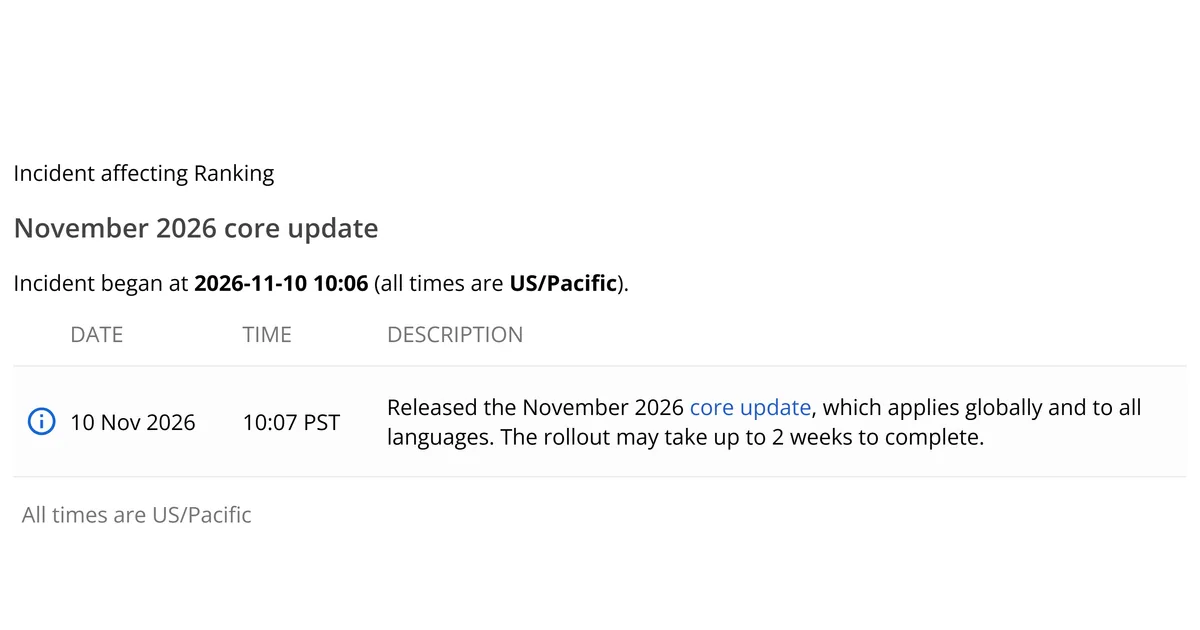
Google released the November 2026 core update on Nov 10, 2026 at 10:06 AM PT (1:06 PM ET), according to its Search Status Dashboard. It applies globally and to all languages, so US search results are included, and Google says the rollout may take up to two weeks.
This report covers what Google has confirmed, what it hasn't said, and how to check your own US traffic once the rollout ends. We'll update it when Google posts an end date.
Key takeaways
What Google has confirmed
The dashboard entry is short. This is everything it says, as of Nov 10, 2026:
| Detail | What Google says |
|---|---|
| Name | November 2026 core update |
| Released | Nov 10, 2026 at 10:06 AM PT (1:06 PM ET) |
| Scope | Applies globally and to all languages |
| Expected length | May take up to 2 weeks to complete |
| Status | Rolling out. No end date was posted when we checked on Nov 10, 2026. |
Source: Google Search Status Dashboard, accessed Nov 10, 2026.
Google's own description, as Search Engine Roundtable quotes it from a Google post on LinkedIn, is that this is a regular update that aims to surface "relevant, satisfying content for searchers from all types of sites." We haven't seen that post ourselves, so treat the wording as secondhand.
Google's core update documentation explains what that means in practice. Core updates are broad changes that "don't target specific sites or individual web pages," and most sites don't need to worry about them. A page that drops hasn't necessarily done anything wrong. Other pages may simply have moved above it.
What Google hasn't said
Google has not said:
- which signals or systems changed
- which kinds of sites or searches are most affected
- when the rollout will finish (two weeks is a ceiling, not a date)
There is also no reliable impact data yet. The rollout has only just begun, and any winners-and-losers list or ranking-tracker chart this early shows a half-finished rollout.
Search Engine Roundtable said it saw big ranking movements earlier in the week, before the announcement, and that some people thought they looked like a core update. Google's official start is Nov 10, so check the date of any change in your data against that before you blame the update.
How it compares with recent core updates
The Search Status Dashboard's Ranking history lists the last three core updates:
| Core update | Started | Finished | Length |
|---|---|---|---|
| December 2025 | Dec 11, 2025 | Dec 29, 2025 | 18 days, 2 hours |
| March 2026 | Mar 27, 2026 | Apr 8, 2026 | 12 days, 4 hours |
| May 2026 | May 21, 2026 | Jun 2, 2026 | 11 days, 21 hours |
| November 2026 | Nov 10, 2026 | Still rolling | Up to 2 weeks (Google's estimate) |
Source: Google Search Status Dashboard, Ranking history, accessed Nov 10, 2026.
If this one runs as long as those three, it would finish between Nov 22 and Nov 28. Google's two-week ceiling points to Nov 24.
This is the third core update on the dashboard in 2026, after March and May. It began about five months after the May update finished. The September 2026 spam update ended on Oct 8, so no other confirmed ranking update is running alongside this one. That makes it easier to link a change to it, but Google also makes smaller changes it doesn't announce, so a matching date is a clue, not proof.
You can follow every confirmed update, with dates, in our Google Update Tracker.
What to check in Search Console (US view)
Google's documentation lays out a simple process. Here it is with US details added.
- Wait for the end date. Check the dashboard for the official finish, then wait a full week. If Google marks the rollout complete on Nov 24, start your analysis around Dec 1.
- Set your baseline. Google's advice is to compare against the week before the update started. That is Nov 3 to Nov 9, 2026. Search Console shows dates in Pacific Time, so a day there won't line up exactly with Eastern Time.
- Filter to the United States. In the Performance report, add a Country filter for United States and compare the two date ranges. If you're unsure what Search Console measures compared with Google Analytics, see our explainer.
- Split by search type. Check Web, Image, Video and News separately, as Google suggests. A drop in one doesn't mean a drop in all.
- Look at pages and queries, not just the total. Google's examples: a move from position 2 to 4 needs no drastic action, while a move from position 4 to 29 deserves a deeper look.
- Account for the holidays. Thanksgiving is Nov 26 and Black Friday is Nov 27, inside or just after the rollout window. For retail, travel, gift and coupon pages, seasonal swings can look like update effects. This is our suggestion, not Google's: compare the same pages around Thanksgiving last year before you decide what the update did.
- Rule out other causes. Check the Manual actions report, look for indexing or server errors, and list any site changes on those dates, such as a redesign, migration,
robots.txtedit or accidentalnoindex.
If your traffic drops after it finishes
Google says a sustained, large drop across your whole site is the case worth acting on. Read its guide to creating helpful, reliable, people-first content, assess the site honestly, and ask people unaffiliated with it to do the same. Then look at the most affected pages and ask whether other pages now do a better job for the searcher.
Don't expect a quick turnaround. Google says some improvements can show up in a few days, but it can take several months for its systems to confirm that a site is consistently helpful, and you may have to wait for a later core update. It also says there is no guarantee that changes will have a noticeable effect.
Update log
- Nov 10, 2026: Published on the first day of the rollout. We'll add the end date and a plain account of what we see once Google marks it complete.
Sources
All accessed Nov 10, 2026.
- Google Search Status Dashboard: November 2026 core update and Ranking history.
- Google Search Central: Google Search's core updates and your website, last updated Dec 10, 2025.
- Google Search Central: Creating helpful, reliable, people-first content, last updated Oct 5, 2026.
- Google Search Console Help: Performance report (Search results): Overview, Dimensions and data groupings and Manual actions report.
- Search Engine Roundtable: Google November 2026 Core Update Is Rolling Out, by Barry Schwartz, Nov 10, 2026 (the source for Google's LinkedIn wording).
- Hero image: screenshot of the incident page on the Google Search Status Dashboard, cropped, captured Nov 10, 2026.
Frequently asked questions
How long will the November 2026 core update take?
Google says the rollout may take up to two weeks from Nov 10, which would be about Nov 24. The three most recent core updates ran between about 12 and 18 days, so a finish between Nov 22 and Nov 28 is plausible. The Search Status Dashboard will show the official end date.
Is the November 2026 core update a penalty?
No. Google describes core updates as broad changes that don't target specific sites or pages. A page that moves down isn't necessarily bad, because other pages may now rank above it. A manual action is a different thing, and it appears in Search Console's Manual actions report.
When should I check my Search Console data?
Wait until the Search Status Dashboard marks the rollout complete, then wait one more full week. Compare that week with the seven days before the update started (Nov 3 to Nov 9, 2026), and filter the report to the United States.
Should I change my content now?
Not because of early data. Google advises against quick-fix changes and against changing content that already performs well. If you see a large, sustained drop after the rollout ends, review the affected pages against Google's helpful content guidance first.
Share
X (opens in a new tab)LinkedIn (opens in a new tab)WhatsApp (opens in a new tab)Akif Qureshi has worked in SEO for more than two years, auditing sites, planning content and tracking how Google updates change real traffic. He started SERP Times to report search changes clearly and to say exactly what site owners should do about them.
Certifications
- Google Analytics (Google)
- Google Ads Search (Google)
- HubSpot
- Digital Vidya
- DSIM
- Internship Studio