
SEOGuide
Meta Description Length: How Long Should It Be?
Google sets no limit on meta descriptions, cuts them by width and replaces them with its own text more often than not. Here's the length that works, with the data behind it.

By Akif Qureshi
Published 7 min read
On this page
The best meta description length is about 120 to 150 characters, which fills the roughly 920 pixels Google shows on a desktop result without being cut off. Google itself sets no limit, though, and it replaces your description with text from the page more often than it shows it.
So length is only half the job. This guide covers what Google says about descriptions, how often it rewrites them according to the studies that measured it, why pixels matter more than characters, and how to write one Google is more likely to keep.
Key takeaways
What Google says about meta description length
Google's documentation on snippets answers the length question directly: "There's no limit on how long a meta description can be," and snippets are cut "as needed, typically to fit the device width."
Two other lines from the same page explain why your description often doesn't appear:
- Snippets are "primarily created from the page content itself."
- Google uses the meta description when it gives a more accurate summary of the page than the page text does for that search.
That second point matters. The snippet is picked per search, so the same page can show your description for one query and a sentence from the page for another.
Google also says descriptions don't affect ranking. Its 2009 announcement about the keywords tag put it plainly: "we still don't use the description meta tag in our ranking."
How often Google rewrites meta descriptions
Google doesn't publish a rewrite rate. Two large studies measured it, both in 2020:
| Study | Sample | Result |
|---|---|---|
| Ahrefs, updated Oct 9, 2020 | 20,000 keywords, desktop results | Description rewritten 62.78% of the time |
| Portent, Sep 10, 2020 | About 30,000 keywords, first page of results | Rewritten 68% on desktop, 71% on mobile |
Both found the same pattern: longer, more specific searches get rewritten more often. Ahrefs measured 59.65% for high-volume "fat head" keywords and 65.62% for long-tail ones. That fits Google's explanation: a long query asks about one detail, and a sentence from the page answers that detail better than a general summary.
We couldn't find a newer study with a published method, so treat these numbers as the best available benchmark, not today's exact rate. The point holds either way: your description is a suggestion, and it wins most often for broad searches such as your brand name or the main topic of the page.
Characters vs. pixels
Like titles, descriptions are cut by width, not by character count. Our tools estimate desktop descriptions with Arial's letter widths at 14 pixels and about 920 pixels of space, which is two lines.
To see what that means in characters, we ran the calculation on the descriptions of all 29 articles on SERP Times. They averaged 6.35 pixels per character, so about 145 characters of ordinary sentence-case text fill 920 pixels (920 ÷ 6.35 ≈ 145). Individual descriptions ranged from 6.07 to 6.67 pixels per character, or roughly 138 to 152 characters.
Here's how the same calculation treats a few examples:
| Description | Characters | Width | Result |
|---|---|---|---|
| A tax preparer in Charlotte, NC: "Need help with taxes? We prepare federal and state returns for freelancers and small businesses in Charlotte, NC, with flat fees from $199." | 139 | 861 px | Fits |
| An Austin dentist: "Same-week cleanings, fillings and Invisalign in South Austin. Most PPO plans accepted, evening and Saturday hours. Book your visit online in two minutes." | 153 | 961 px | Cut after "two" |
| A boot store, sentence case | 154 | 961 px | Cut near the end |
| The same boot store text in all caps | 154 | 1,276 px | Cut after about 100 characters |
So the common "155 to 160 characters" advice is a ceiling for narrow text, not a target. If you aim for 120 to 150 characters and put the important part first, a cut costs you nothing that matters.
Dates and mobile
Two things shorten the space you get:
- Dates. When Google shows a date for a result, usually for news and time-sensitive pages, the date sits at the start of the snippet and uses part of the room.
- Phones. Mobile results are narrower, so the text wraps over more lines and a long description is more likely to end in "...". Portent's data also showed a slightly higher rewrite rate on mobile.
How to write a description Google is more likely to keep
Google's snippet guidelines boil down to a few habits:
- Summarize the whole page, like a short pitch. A product page for a Shopify store shipping across the US could say what the product is, the price and the shipping terms.
- Include real details: price, location, hours, author, date or manufacturer, where they help.
- Make every description unique. Google says identical or similar descriptions across pages aren't helpful. If you can't write them all, start with the home page and your most popular pages.
- Generate them from data on large sites. Google says programmatic descriptions are appropriate for big database-driven sites, as long as they're readable and varied.
- Don't stuff keywords. Google says keyword lists are less likely to be shown.
- Lead with the point. If only the first line survives, it should still make sense.
To check a whole site for missing and duplicate descriptions, paste a crawl export into the Bulk Title & Description Checker. Duplicates usually come from the same template problems that cause duplicate title tags.
Controlling snippets
If you need to limit what Google shows, the robots meta tag gives you three controls:
nosnippetshows no text snippet for the page.max-snippet:[number]caps the snippet at that many characters.data-nosnippeton adiv,spanorsectionkeeps that part of the page out of snippets.
Use them only when you have a reason, such as text that must not appear out of context. A missing snippet usually means fewer clicks.
Preview your description with our free tool
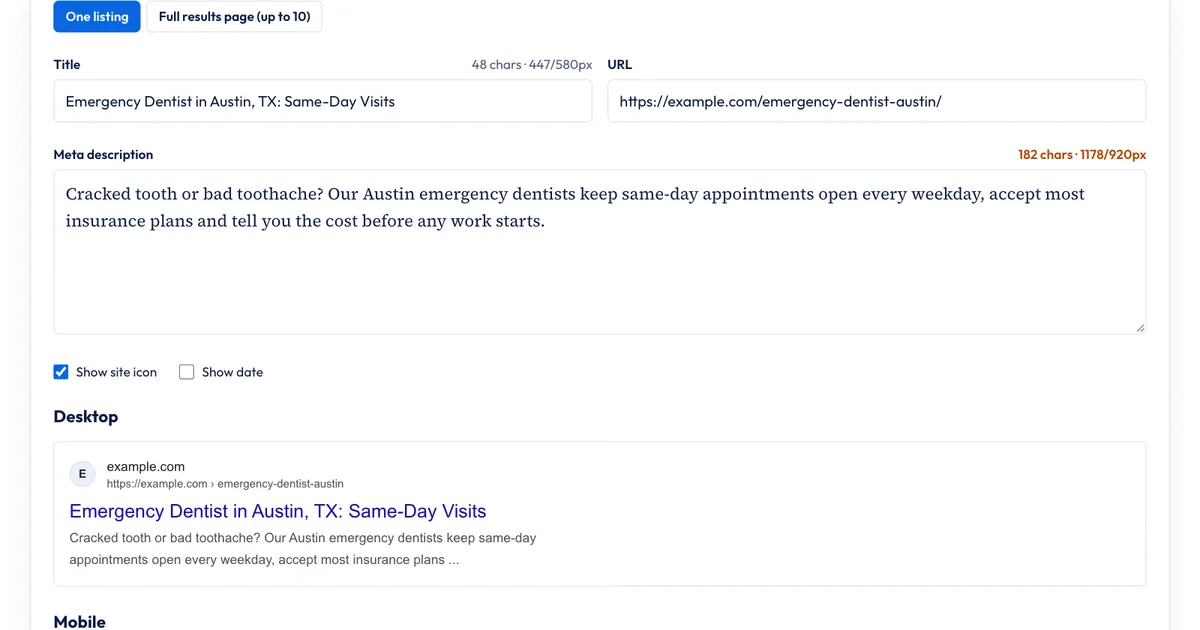
Our SERP Snippet Preview shows how a result could look on desktop and mobile:
- Keep "One listing" selected, then enter the page title, URL and meta description.
- Turn "Show date" on if your page is news or time-sensitive, and pick the date, to see how much room it takes.
- Compare the desktop and mobile previews. The desktop one cuts the description where our pixel estimate says Google would.
- Switch to "Full results page (up to 10)" to add competing results and see how your snippet reads next to them.
It doesn't read a live page or predict whether Google will rewrite your description. To get the exact character and pixel count, use the Meta Title & Description Checker. For titles, see our guide to meta title length.
When you need more than a preview
A preview is enough to write and polish descriptions. For the rest:
- To see what Google shows, search for the page yourself in a private window, with the queries it ranks for.
- To see whether a new description earns more clicks, compare the page's click-through rate in Search Console's Performance report for the same length of time before and after the change.
- To audit thousands of pages, use a crawler that exports every description, then check the export in bulk.
Sources
- Control your snippets in search results, Google Search Central, accessed Nov 20, 2026
- Robots meta tag, data-nosnippet, and X-Robots-Tag specifications, Google Search Central, accessed Nov 20, 2026
- Google does not use the keywords meta tag in web ranking, Google Search Central Blog, September 21, 2009, accessed Nov 20, 2026
- How Often Does Google Rewrite Meta Descriptions?, Ahrefs, updated October 9, 2020, accessed Nov 20, 2026
- Study: How Often Google Ignores and Rewrites Our Meta Descriptions, Portent, September 10, 2020, accessed Nov 20, 2026
- Pixel widths: SERP Times calculation with Arial letter widths at 14 px, the method used by our SERP tools, Nov 20, 2026
Frequently asked questions
What happens if a page has no meta description?
Google writes a snippet from the page's text, as it does for most results anyway. Nothing is penalized. But you lose the one place where you can suggest a summary, which matters most for your home page and other pages that rank for broad searches.
Can a meta description be too short?
Yes. Google's documentation says it prefers specific, detailed descriptions to very short or vague ones. Under about 70 characters you usually have room to add a useful detail such as a price, a location or what makes the page different.
How long does it take for a new meta description to show in Google?
Until Google recrawls the page, which can take days or weeks. You can ask for a recrawl with URL Inspection in Search Console. Even after that, Google may still show text from the page instead of your description for some searches.
Should the keyword be in the meta description?
Include it where it reads naturally, because the description should summarize the page and the keyword usually describes the page. Don't list keywords: Google says descriptions made of keyword lists are less likely to be shown.
Share
X (opens in a new tab)LinkedIn (opens in a new tab)WhatsApp (opens in a new tab)Akif Qureshi has worked in SEO for more than two years, auditing sites, planning content and tracking how Google updates change real traffic. He started SERP Times to report search changes clearly and to say exactly what site owners should do about them.
Certifications
- Google Analytics (Google)
- Google Ads Search (Google)
- HubSpot
- Digital Vidya
- DSIM
- Internship Studio