
ContentGuide
Title Case Rules: AP vs. Chicago vs. APA vs. MLA
Every style capitalizes the first, last and major words in a title. They split on prepositions, and Chicago changed its rule in 2024. Here's each style side by side, with worked examples.

By Akif Qureshi
Published 9 min read
On this page
Title case rules tell you to capitalize the first word, the last word and every major word in a title, and to lowercase short minor words such as a, and and of in the middle. The four big US style guides (AP, Chicago, APA and MLA) agree on that much. They disagree on prepositions, and Chicago changed its rule in 2024, which many online guides haven't caught up with.
This guide sets out the rules each style shares, then where they differ, with the same titles written in all four styles.
Key takeaways
The title case rules every style agrees on
Whichever guide you follow, these rules hold:
- Capitalize the first word of the title, and the first word of a subtitle after a colon.
- Capitalize the last word, even if it's short (What Dreams Are Made Of).
- Capitalize the major words: nouns, pronouns, verbs, adjectives and adverbs. Length doesn't matter for these. Is, Be, It and Our are all capitalized, because they're a verb or a pronoun, not minor words.
- Lowercase the articles a, an and the in the middle of a title.
- Lowercase the common coordinating conjunctions and, but, or and nor in the middle of a title.
- Keep proper nouns and brand names as they're spelled: iPhone, eBay, YouTube, GA4.
The arguments are almost all about prepositions (of, to, in, with, from, about, through) and a few short words like so, yet and if.
Where AP, Chicago, APA and MLA disagree
| Rule | AP | Chicago (18th ed.) | APA (7th ed.) | MLA (9th ed.) |
|---|---|---|---|---|
| Prepositions | Capitalize 4+ letters | Capitalize 5+ letters | Capitalize 4+ letters | Lowercase all |
| With, from, into | With, From, Into | with, from, into | With, From, Into | with, from, into |
| About, after, under | About, After, Under | About, After, Under | About, After, Under | about, after, under |
| Short conjunctions (and, or) | Lowercase | Lowercase | Lowercase | Lowercase |
| Where it's used | Titles of works (news headlines use sentence case) | Titles of works and headings | Paper titles, headings, works named in text | Titles of English-language works |
AP: four letters or more, and headlines are different
The AP Stylebook tells you to capitalize the principal words in the titles of books, movies, songs and other compositions, including prepositions and conjunctions of four or more letters. Articles and words of fewer than four letters are capitalized only when they start or end the title.
The catch: AP doesn't use title case for news headlines. AP-style headlines capitalize only the first word and proper nouns, which is sentence case. Many blogs and press releases borrow AP's composition-title rule for their headlines anyway. That's a house style choice, not what AP itself does. (The AP Stylebook is subscription-only, so check the current composition titles and headlines entries if you follow AP closely.)
Chicago: the 2024 change to prepositions
For decades, Chicago lowercased prepositions in titles regardless of length, which produced titles like A River Runs through It. The 18th edition of The Chicago Manual of Style, published in 2024, changed that. Prepositions of five or more letters are now capitalized; prepositions of four letters or fewer stay lowercase.
So in Chicago style today:
- Writing Under a Deadline (Under has five letters)
- Notes from the Field (from has four)
- A River Runs Through It (Through has seven)
Chicago keeps a few rules of its own. It lowercases to and as in any use, and it capitalizes a preposition used as an adverb or adjective, as in the phrasal verb Turn On. It lowercases only and, but, for, or and nor among the conjunctions, so Yet and So get a capital. If you learned Chicago before 2024, or you're reading a guide that doesn't mention the 18th edition, its preposition advice is out of date.
APA: any word of four letters or more
The APA Style website's title case page says to capitalize major words and any word of four letters or more, and to lowercase only minor words of three letters or fewer: short conjunctions, short prepositions and all articles. APA also capitalizes the second part of a hyphenated major word (Self-Report) and the first word after a colon or a dash.
APA uses title case for the title of your paper, for headings and for the titles of works you mention in the text. In the reference list, article and book titles switch to sentence case. That trips up a lot of students.
MLA: lowercase every preposition
The MLA Style Center says titles of English-language works are capitalized headline-style, and that a preposition inside a title stays lowercase no matter how long it is or how many words it has. Its example is The World according to Garp. MLA also lowercases articles and coordinating conjunctions in the middle of a title. Titles in other languages follow sentence-style capitalization instead.
The same titles in all four styles
Here's how five titles come out under each rule. Differences are where the prepositions are.
| AP and APA | Chicago (18th ed.) | MLA |
|---|---|---|
| How to Recover From a Google Core Update | How to Recover from a Google Core Update | How to Recover from a Google Core Update |
| What to Do After a Core Update | What to Do After a Core Update | What to Do after a Core Update |
| A Guide to Local SEO With Google Business Profile | A Guide to Local SEO with Google Business Profile | A Guide to Local SEO with Google Business Profile |
| Black Friday Email Ideas for Shopify Stores | Black Friday Email Ideas for Shopify Stores | Black Friday Email Ideas for Shopify Stores |
| Why Is My Site Not in Google? | Why Is My Site Not in Google? | Why Is My Site Not in Google? |
As an AP news headline, the first one would be written in sentence case: How to recover from a Google core update.
Tricky cases
- Phrasal verbs. In How to Set Up Google Analytics 4, Up is part of the verb, not a preposition, so it's capitalized. Compare Walk up the Stairs in MLA, where up is a preposition.
- Hyphenated words. Capitalize the first part, and the second part if it's a major word: Step-by-Step Guide, Long-Term Results. Step-by-Step keeps by lowercase in most styles because it's a preposition.
- After a colon. Every style capitalizes the first word of a subtitle: Core Updates: A Plain-English Guide.
- Numbers and symbols. They aren't affected. 10 Ways to Speed Up WordPress stays as it is.
- Brands that start with a lowercase letter. Keep the brand's spelling, even at the start: iPhone Tips for Small Business Owners. Some editors rewrite the title to avoid starting with one.
Title case or sentence case?
Sentence case capitalizes only the first word and proper nouns: How to recover from a Google core update. It's easier to apply, because there are no word lists to remember, and it reads like ordinary text.
Who uses which is a style decision, not a rule:
- Google's developer documentation style guide uses sentence case for titles and headings.
- Many US newspapers and AP-style newsrooms use sentence case for headlines.
- Plenty of blogs and marketing sites use title case for headlines, often with sentence case for subheadings.
For search, either is fine. Google's guidance on title links asks for titles that are descriptive and concise, and it says nothing about capitalization. Pick one style, write it into your style guide and use it on every page. If you also care about how long your titles run in Google, see our guide to meta title length.
How to convert a title with our Case Converter
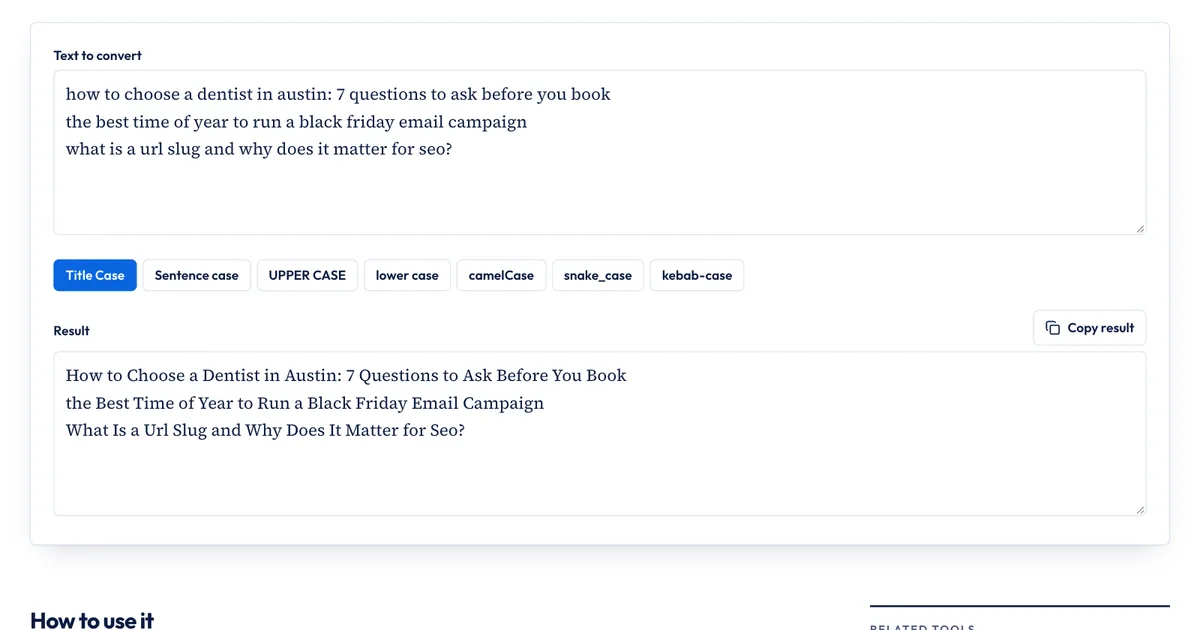
Our Case Converter turns a title into title case in one click:
- Paste the title, or a list of titles with one per line.
- Choose Title Case under Convert to.
- Check the result, then copy it with Copy result.
What its title case does, so you know what to check:
- It lowercases these words in the middle of a title: a, an, and, as, at, but, by, en, for, if, in, nor, of, off, on, or, per, so, the, to, up, via, vs. and yet. Longer words such as With, From, Into and About get a capital. That matches the AP and APA rule.
- It capitalizes the first and last word and the first word after a colon or a dash.
- It keeps words you typed with inner capitals as they are, such as SEO, GA4 and iPhone. Type acronyms in capitals: if you type seo, you get Seo.
What it doesn't do: it can't tell a phrasal verb from a preposition, so Set Up becomes Set up and needs a manual fix. For Chicago or MLA, lowercase the longer prepositions by hand (with, from and into for Chicago; all prepositions for MLA). For sentence case, choose Sentence case instead.
If you're writing a headline from scratch, our headline analyzer guide covers how to check its length and clarity before you settle on the capitalization.
Which style should you follow?
- School and academic papers: the one your instructor or journal names, usually APA in the social sciences and MLA in the humanities.
- Books and long-form publishing: Chicago.
- News and PR: AP, with sentence case headlines.
- Your own blog or business site: any of them. AP-style title case is the easiest to apply consistently, in my view, because the rule fits in one line: capitalize every word of four letters or more.
The style matters less than consistency. A site where every headline follows the same rule looks edited. One that mixes styles looks rushed.
Sources
- Title case, APA Style, American Psychological Association, accessed Nov 20, 2026.
- Why does the MLA capitalize certain words in titles?, MLA Style Center, accessed Nov 20, 2026.
- In MLA style, should any part of a two-word preposition, such as "according to," be capitalized in a title?, MLA Style Center, accessed Nov 20, 2026.
- Chicago Manual of Style Q&A: Headlines and Titles of Works, University of Chicago Press, accessed Nov 20, 2026.
- 5 Changes That Matter From The Chicago Manual of Style, 18th Edition, Writer's Digest, September 20, 2024, accessed Nov 20, 2026.
- AP Stylebook, The Associated Press (subscription), accessed Nov 20, 2026.
- Capitalization, Google developer documentation style guide, accessed Nov 20, 2026.
- Influencing your title links in search results, Google Search Central, accessed Nov 20, 2026.
Frequently asked questions
Do you capitalize "and" in a title?
Not in the middle of a title. AP, Chicago, APA and MLA all lowercase "and" unless it's the first or last word. The same goes for "but," "or" and "nor."
Should "the" be capitalized in a title?
Only when it's the first word of the title or of a subtitle after a colon, as in "The Complete List of Google Updates." In the middle of a title, all four major US style guides lowercase "the," "a" and "an."
Is "with" capitalized in a title?
It depends on the style. AP and APA capitalize it because it has four letters. Chicago (18th edition) lowercases it, since only prepositions of five or more letters are capitalized, and MLA lowercases every preposition.
Should email subject lines and buttons use title case?
No style guide requires it. Many brands use sentence case for subject lines, buttons and menus because it reads like normal text. Whatever you choose, use it everywhere so your emails and site look consistent.
Share
X (opens in a new tab)LinkedIn (opens in a new tab)WhatsApp (opens in a new tab)Akif Qureshi has worked in SEO for more than two years, auditing sites, planning content and tracking how Google updates change real traffic. He started SERP Times to report search changes clearly and to say exactly what site owners should do about them.
Certifications
- Google Analytics (Google)
- Google Ads Search (Google)
- HubSpot
- Digital Vidya
- DSIM
- Internship Studio