
ContentGuide
How Long Does It Take to Read 1000 Words? Times by Speed
An average adult reads 1,000 words of non-fiction in about 4 minutes and 12 seconds, or 5 and a half minutes out loud. Here's where those numbers come from and why your own time may differ.

By Akif Qureshi
Published 7 min read
On this page
How long does it take to read 1000 words? About 4 minutes for an average adult reading non-fiction silently (4 minutes 12 seconds, to be exact), and about 5 and a half minutes reading it out loud.
Those figures come from a 2019 review of 190 reading studies, which put the average adult at 238 words per minute (wpm) for non-fiction. Your own time depends on how fast you read, how hard the text is and whether you're reading every word or skimming. The table below gives the time at several speeds, and the rest of this guide explains where the numbers come from.
Key takeaways
Reading time for 1,000 words at different speeds
The math is simple: words ÷ words per minute = minutes. Here's 1,000 words at common speeds, rounded to the nearest second:
| Speed | What it represents | Time for 1,000 words |
|---|---|---|
| 150 wpm | A slow, careful read | 6 min 40 sec |
| 183 wpm | Average reading aloud (Brysbaert, 2019) | 5 min 28 sec |
| 200 wpm | A round figure many calculators use | 5 min 0 sec |
| 238 wpm | Average silent reading, non-fiction (Brysbaert, 2019) | 4 min 12 sec |
| 260 wpm | Average silent reading, fiction (Brysbaert, 2019) | 3 min 51 sec |
| 265 wpm | Medium's "read time" speed | 3 min 46 sec |
| 300 wpm | A fast reader | 3 min 20 sec |
For most web content, such as a blog post, a news story or a product guide, use the 238 wpm row. It's the most realistic figure for an average adult reading something informative.
Where the 238 words per minute figure comes from
The figure you'll often see quoted is 300 words per minute. In 2019, psychologist Marc Brysbaert published a review and meta-analysis in the Journal of Memory and Language that pooled 190 studies with 18,573 participants. His findings for adults reading in English:
- Silent reading, non-fiction: 238 wpm on average.
- Silent reading, fiction: 260 wpm on average. The paper links the gap to word length: non-fiction tends to use longer words.
- Reading aloud: 183 wpm on average.
The British Psychological Society's summary of the review notes Brysbaert's conclusion that a target of 300 wpm "is unrealistic for the majority of people." So if your 1,000 words take closer to 5 minutes than 4, you're not slow. You're normal.
Two limits are worth knowing. The review covered adults aged 17 to 60 reading for comprehension, not skimming. And individual speeds vary widely, so the average is a planning number, not a measure of any one reader.
Why "X min read" labels disagree
You may see the same 1,000-word article labeled "4 min read" on one site and "5 min read" on another. Three things cause that:
- Different speeds. Medium's help center says its read time uses roughly 265 wpm, which turns 1,000 words into a 4-minute label. A tool that uses 200 wpm says 5 minutes.
- Images and extras. Medium adds time for images. Other sites ignore them, or count captions, code and table text as words.
- Rounding. 4 minutes 12 seconds might be shown as "4 min" or rounded up to "5 min."
None of these is wrong. Pick one speed for your own site and use it everywhere, so a "6 min read" means the same thing on every page.
How long it takes to read other lengths
At 238 wpm silent and 183 wpm aloud:
| Words | Silent (238 wpm) | Aloud (183 wpm) |
|---|---|---|
| 300 | 1 min 16 sec | 1 min 38 sec |
| 500 | 2 min 6 sec | 2 min 44 sec |
| 750 | 3 min 9 sec | 4 min 6 sec |
| 1,000 | 4 min 12 sec | 5 min 28 sec |
| 1,500 | 6 min 18 sec | 8 min 12 sec |
| 2,500 | 10 min 30 sec | 13 min 40 sec |
| 5,000 | 21 min 1 sec | 27 min 19 sec |
The aloud column is useful if you're turning a post into a podcast segment, a YouTube script or a presentation. A 1,000-word script runs a little over 5 minutes at an average reading-aloud pace, and longer if you pause for slides or questions.
What changes how long 1,000 words takes
The averages above assume plain, connected prose. Real pages vary:
- Difficulty. Long words and long sentences slow everyone down. A 1,000-word explainer on Section 179 tax deductions takes longer than a 1,000-word restaurant review. You can measure this with a readability score; our guide to the Flesch Reading Ease score explains how.
- Skimming. Most people don't read web pages word for word. In a 2008 Nielsen Norman Group analysis of browser logs, Jakob Nielsen estimated that visitors read about 20% of the words on an average page, and at most 28%. The data is old and the sample small, but the pattern still shapes how people use the web: they scan for the part they need.
- Tables, lists and code. A pricing table or a code sample takes longer per word than a paragraph, because readers stop to compare and check.
- Purpose. Studying for an exam or reviewing a contract is slower than reading a news update over coffee.
This is why reading time works best as a rough guide for the reader, such as "this is a 4-minute read," and not as a promise.
How to check the reading time of your own text
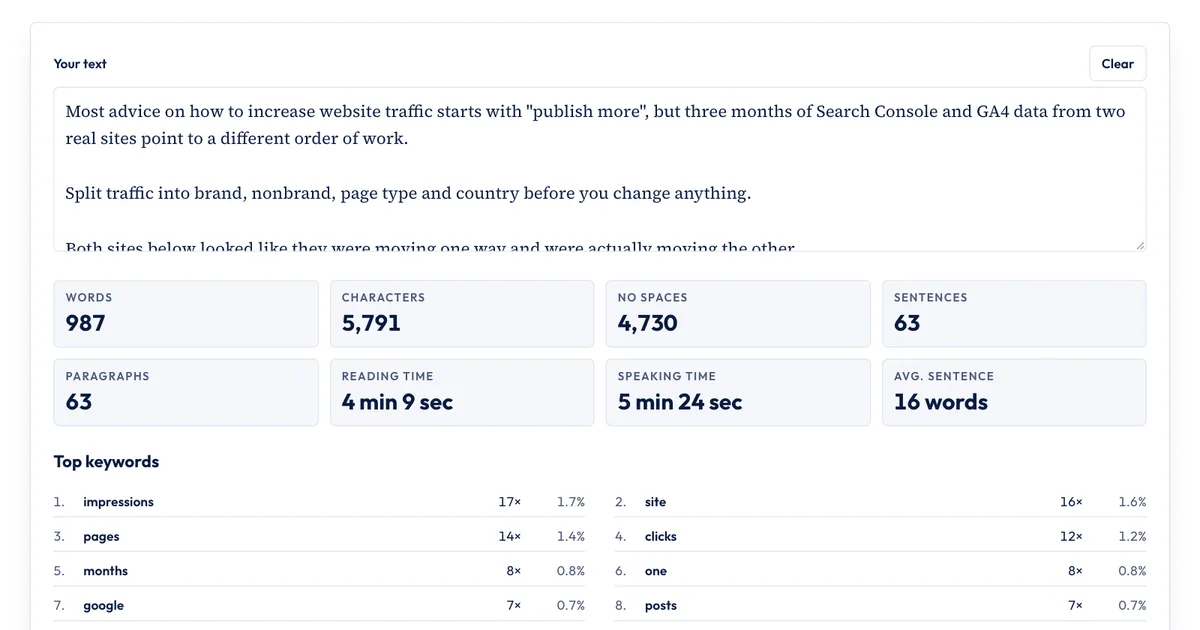
If you have a draft, you don't need to count words and divide by hand. Our Word & Character Counter does it as you type:
- Paste or type your text into the box. The counting happens in your browser, so nothing is uploaded.
- Read the Words count and the Reading time tile. Reading time uses 238 wpm, so 1,000 words shows as 4 min 12 sec.
- Check Speaking time (183 wpm) if the text will be read aloud, such as a script, a voicemail greeting or a webinar intro.
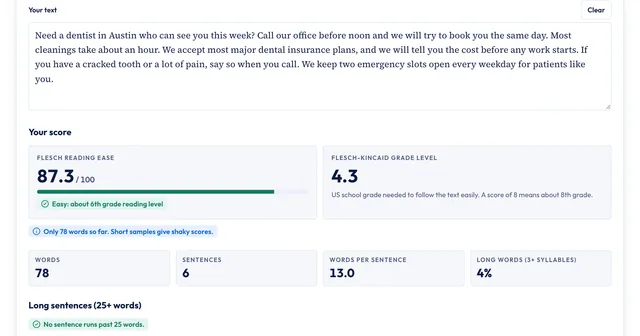
- Look at Avg. sentence. If it's well above 20 words, the text will probably take longer to read than the estimate suggests.
What it doesn't do: it doesn't add time for images, it counts every word the same whether it's in a paragraph or a table, and it can't measure your personal reading speed. For a personal figure, time yourself reading a page of a typical book or article and divide the words by the minutes.
Should you write to a reading time?
No. Google says in its guide to creating helpful content that it doesn't have a preferred word count. A page ranks because it answers the question well, not because it hits 1,000 words or a 4-minute read.
Reading time is still useful for planning:
- Email newsletters. A Black Friday promo email is skimmed in seconds. Keep it short enough to read on a phone between other emails.
- Help articles. A "how to reset your password" page should be a one-minute read. If it's five, split it up.
- Long guides. A 3,000-word guide on preparing for tax season is fine if every section earns its place. Add a table of contents so readers can jump to their part.
If you want more people to find and finish your pages, the bigger levers are covered in our guide to increasing website traffic: answer real questions, update what's out of date and make pages easy to scan.
Sources
- How many words do we read per minute? A review and meta-analysis of reading rate, Marc Brysbaert, Journal of Memory and Language, vol. 109, 2019, accessed Nov 20, 2026.
- Most comprehensive review to date finds the average person's reading speed is slower than previously thought, Matthew Warren, British Psychological Society Research Digest, June 13, 2019, accessed Nov 20, 2026.
- Read time, Medium Help Center, accessed Nov 20, 2026.
- How Little Do Users Read?, Jakob Nielsen, Nielsen Norman Group, May 5, 2008, accessed Nov 20, 2026.
- Creating helpful, reliable, people-first content, Google Search Central, accessed Nov 20, 2026.
Frequently asked questions
How many words is a 5-minute read?
About 1,190 words at the average silent reading speed of 238 words per minute (5 × 238). If a site labels its articles with a faster speed, such as Medium's 265 words per minute, a 5-minute label covers about 1,325 words.
Is 300 words per minute a good reading speed?
Yes. It's faster than average. Brysbaert's 2019 review of 190 studies put the typical adult at 238 words per minute for non-fiction, and it argued that the often-quoted 300 words per minute is too high to be a realistic target for most people.
How long does it take to read 2,000 words?
About 8 minutes and 24 seconds silently at 238 words per minute, and about 11 minutes out loud at 183 words per minute.
Do reading time labels help SEO?
Google hasn't said it uses them. A reading time label is for your readers: it sets expectations before they start. Google's own guidance says it has no preferred word count, so write to the length the topic needs.
Share
X (opens in a new tab)LinkedIn (opens in a new tab)WhatsApp (opens in a new tab)Akif Qureshi has worked in SEO for more than two years, auditing sites, planning content and tracking how Google updates change real traffic. He started SERP Times to report search changes clearly and to say exactly what site owners should do about them.
Certifications
- Google Analytics (Google)
- Google Ads Search (Google)
- HubSpot
- Digital Vidya
- DSIM
- Internship Studio