
ContentGuide
Flesch Reading Ease Score: Formula, Chart and Targets
The Flesch Reading Ease score rates text from about 0 to 100 using only sentence length and syllables per word. Here's the formula, what each score means and the target worth aiming for on the web.

By Akif Qureshi
Published 8 min read
On this page
The Flesch Reading Ease score rates how easy a text is to read on a scale that usually runs from 0 to 100, where higher scores mean easier text. It uses only two things: how many words your sentences have on average, and how many syllables your words have.
For most web pages, a score of 60 or higher is a good target. That's plain English an 8th or 9th grader can follow. This guide covers the formula, what each score band means, what counts as "good" for different kinds of content, and a worked example of fixing a low score.
Key takeaways
The Flesch Reading Ease formula
Rudolf Flesch published the formula in the Journal of Applied Psychology in 1948:
Reading Ease = 206.835 − (1.015 × ASL) − (84.6 × ASW)

ASL = average sentence length = words ÷ sentences
ASW = average syllables per word = syllables ÷ words
Each extra syllable per word (on average) costs 84.6 points, and each extra word per sentence costs about 1 point. Both matter in practice. Average sentence length can swing by 20 or more words between two drafts, while syllables per word moves in a much narrower range: from 1.72 to 1.30 in the worked example below.
A quick example: a 100-word passage with 5 sentences and 140 syllables has an ASL of 20 and an ASW of 1.4.
206.835 − (1.015 × 20) − (84.6 × 1.4)
= 206.835 − 20.3 − 118.44
= 68.1
A score of 68 sits in the "standard" or plain English band.
Flesch Reading Ease score chart
Flesch matched score ranges to the US school grade a reader needs. Tools label the bands slightly differently, but the ranges are the same:
| Score | Reading level | Typical reader |
|---|---|---|
| 90–100 | Very easy | 5th grade |
| 80–89 | Easy | 6th grade |
| 70–79 | Fairly easy | 7th grade |
| 60–69 | Standard (plain English) | 8th–9th grade |
| 50–59 | Fairly difficult | 10th–12th grade |
| 30–49 | Difficult | College |
| 0–29 | Very difficult | College graduate |
The scale isn't capped. A text of very long sentences full of long words can score below 0, and a run of one-syllable words in short sentences can score above 100. Most tools, including ours, show those as 0 or 100.
What is a good Flesch Reading Ease score?
It depends on who's reading and why:
- General web content (blog posts, local business pages, product pages, help articles): aim for 60 or higher. A dentist in Austin or a plumber in Phoenix is writing for everyone in town, not for specialists.
- Microsoft's guidance: Word's help page on readability statistics recommends a Flesch Reading Ease score of 60 to 70 and a Flesch-Kincaid grade level of about 7.0 to 8.0 for most standard documents.
- Legal minimums: some US rules set a floor. Florida law, for example, requires most insurance policy forms filed in the state to reach at least 45 on the Flesch test, and it spells out the formula and the counting rules in the statute.
- Technical and B2B content: a guide to Section 179 depreciation or Kubernetes autoscaling can easily land below 50 because the necessary terms are long. That's fine if the sentences are short and the terms are explained.
The score is a signal, not a goal. Don't swap a precise word for a vague one just to gain points.
Flesch Reading Ease vs. Flesch-Kincaid Grade Level
The Flesch-Kincaid Grade Level uses the same two averages with different weights, and it gives a US school grade instead of a 0–100 score:
Grade level = (0.39 × ASL) + (11.8 × ASW) − 15.59J. Peter Kincaid and colleagues derived it in 1975 in a research report for the US Navy, which recalculated three readability formulas, Flesch's among them, for Navy enlisted personnel. A grade level of 8.0 means a typical 8th grader can follow the text.
The two move in opposite directions: a higher Reading Ease is easier, while a higher grade level is harder. Microsoft Word shows both, and so does our Readability Scorer.
A worked example: fixing a low score
Here's a paragraph of the kind you might find on a dental practice's website. We ran it through our Readability Scorer:
If you are experiencing tooth sensitivity when you drink something cold, we recommend that you schedule an evaluation with one of our dentists, because enamel erosion that is not treated will usually get worse over time and may eventually require a more expensive procedure such as a crown. Our office offers early morning appointments on weekdays as well as appointments on Saturdays in order to accommodate patients who have busy work schedules.
Result: 72 words, 2 sentences, 124 syllables. That's 36 words per sentence and 1.72 syllables per word, for a Reading Ease of 24.6 ("very difficult") and a grade level of 18.8. The first sentence alone runs 48 words.
The rewrite keeps every fact but splits the ideas into short sentences and uses everyday words:
If your teeth hurt when you drink something cold, book a checkup. Worn enamel tends to get worse over time. A small filling now can save you from a crown later. We open early on weekdays and on Saturdays, so you can come in before work.
Result: 46 words, 4 sentences, 60 syllables. That's 11.5 words per sentence and 1.30 syllables per word, for a Reading Ease of 84.8 ("easy") and a grade level of 4.3.
The math for the rewrite: 206.835 − (1.015 × 11.5) − (84.6 × 1.304) = 84.8. Shorter words added about 35 points (84.6 × the drop from 1.72 to 1.30 syllables per word) and shorter sentences about 25 (1.015 × the drop from 36 to 11.5 words). Swaps such as "book a checkup" for "schedule an evaluation" did more for the score than the extra periods.
Why tools give different scores
Paste the same text into Microsoft Word, Yoast and our tool and you'll often see different numbers. The formula is the same. The counting isn't:
- Syllables. No tool looks up every word in a dictionary. Most use rules of thumb, which miss on words like "schedule" or "evaluation." Our tool's syllable rule is usually right within a syllable per word.
- Sentences. Headings, bullet points and lines without a period may be counted as sentences, merged into the next sentence or skipped.
- Numbers, URLs and abbreviations. Some tools count "2027" or "U.S." as words with syllables; ours skips numbers and symbols.
Differences of a point or two are normal. Track the score in one tool over time instead of comparing tools. Yoast, for its part, dropped the Flesch score from its readability analysis in Yoast SEO 19.3 in July 2022 and now checks sentence length and word complexity directly.
Does the Flesch score affect SEO?
Not directly, as far as anyone can show. Google hasn't said it uses a readability formula in ranking, and its guidance on helpful content talks about content that satisfies the reader, not about a target score.
Readable text can still help indirectly: a visitor who understands your page is more likely to act on it, link to it and come back. Just don't expect a higher score on its own to move rankings.
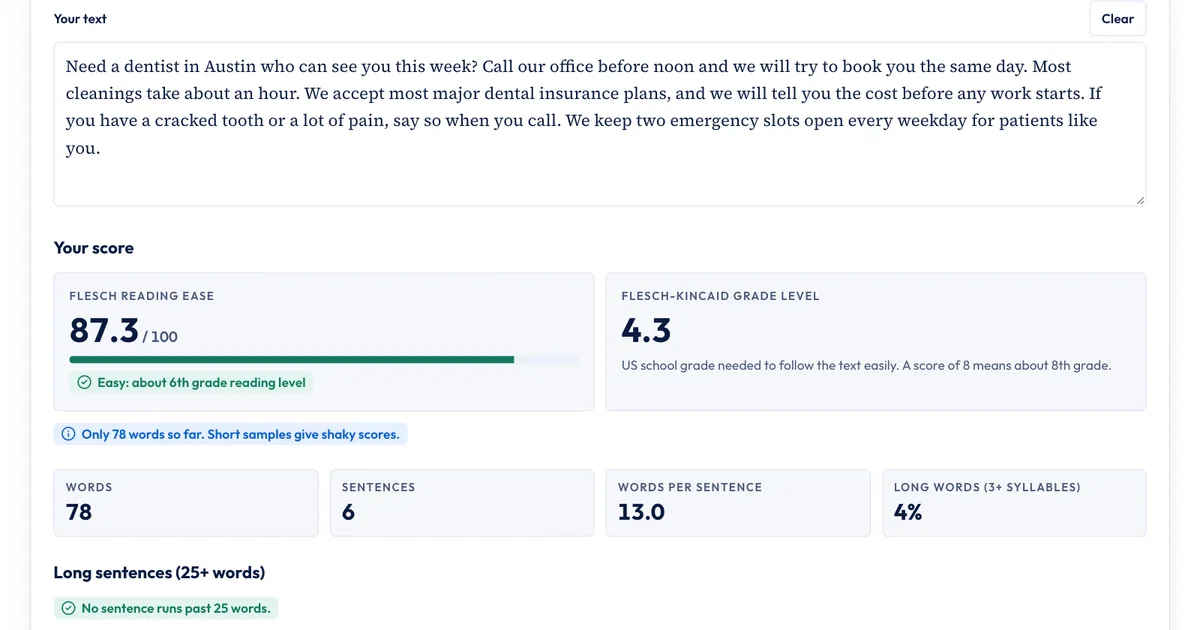
How to check your score with our Readability Scorer
Our free Readability Scorer runs in your browser:
- Paste your article or page copy. Use at least 100 words for a steady score.
- Read the Flesch Reading Ease score, its band label and the reading level next to it, plus the Flesch-Kincaid grade level.
- Check Words per sentence and Long words (3+ syllables) to see which of the two is pulling the score down.
- Work through the Long sentences list. It shows every sentence over 25 words, longest first.
- Paste the edited text again to see the new score.
What it doesn't do: it doesn't check grammar, tone or accuracy, it doesn't suggest replacement words, and it treats headings and list items as ordinary text. For long drafts, paste one section at a time to find the hardest parts. If you also want word counts and reading time, use the Word Counter, and see how long it takes to read 1,000 words for what those numbers mean.
How to raise a low score
- Split long sentences. Anything over 25 words is a candidate. Look for and, because, which and as well as, and end the sentence there.
- Use the everyday word. Use for utilize, help for facilitate, buy for purchase, about for approximately.
- Cut filler phrases. In order to becomes to. Due to the fact that becomes because.
- Turn lists into lists. A sentence that names five services reads better as five bullet points.
- Keep the terms your reader needs. If you write for CPAs, "depreciation" stays. Explain it once and keep the sentence around it short.
Sources
- A new readability yardstick, Rudolf Flesch, Journal of Applied Psychology, vol. 32, no. 3, 1948 (PubMed record), accessed Nov 20, 2026.
- Derivation of New Readability Formulas (Automated Readability Index, Fog Count and Flesch Reading Ease Formula) for Navy Enlisted Personnel, J. Peter Kincaid, Robert P. Fishburne Jr., Richard L. Rogers and Brad S. Chissom, Naval Technical Training Command, Research Branch Report 8-75, February 1975, accessed Nov 20, 2026.
- Get your document's readability and level statistics, Microsoft Support, accessed Nov 20, 2026.
- Section 627.4145, Readable language in insurance policies, Florida Statutes, accessed Nov 20, 2026.
- The Flesch reading ease score: Why & how to use it, Yoast, accessed Nov 20, 2026.
- Creating helpful, reliable, people-first content, Google Search Central, accessed Nov 20, 2026.
Frequently asked questions
Is a higher Flesch Reading Ease score always better?
No. Past a point, a higher score means choppy sentences and missing detail. For most web content, 60 to 80 is a comfortable range. A guide for accountants or developers can score lower and still be the clearest page on the topic.
Does Yoast SEO still show the Flesch Reading Ease score?
Yoast removed it from its readability analysis in Yoast SEO 19.3 (July 2022) and replaced it with sentence length and word complexity checks. Yoast says the score still appears in the Insights tab.
Does the Flesch Reading Ease formula work in other languages?
Not as is. Its constants were fitted to English text, and other languages have longer or shorter average words. Use a readability formula built for that language instead of comparing English scores.
How many words do I need for a reliable score?
At least 100 words, and more is better. With only two or three sentences, one long sentence or one long word moves the score a lot.
Share
X (opens in a new tab)LinkedIn (opens in a new tab)WhatsApp (opens in a new tab)Akif Qureshi has worked in SEO for more than two years, auditing sites, planning content and tracking how Google updates change real traffic. He started SERP Times to report search changes clearly and to say exactly what site owners should do about them.
Certifications
- Google Analytics (Google)
- Google Ads Search (Google)
- HubSpot
- Digital Vidya
- DSIM
- Internship Studio