
AI SearchGuide
What Search Engine Does Claude Use? It's Not Just Brave
Claude's web search started on Brave Search, but Anthropic now lists three web search providers, and Bing supplies its images. Here's what each one does, how we know, and how to get your site into Claude's answers.

By Akif Qureshi
Published 6 min read
On this page
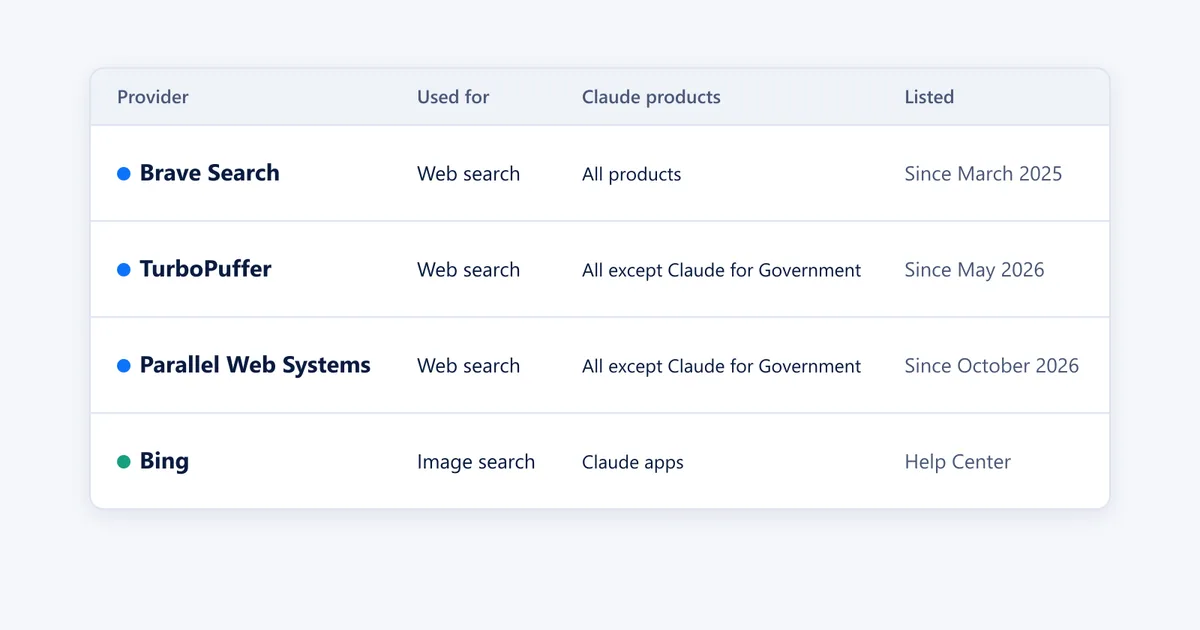
What search engine does Claude use? Mostly Brave Search, but not only Brave: Anthropic's own list of outside service providers names Brave Search, TurboPuffer and Parallel Web Systems for web search in Claude, and its help center says image results come from Bing.
Most articles on this topic still say "Claude uses Brave," which was the full story in 2025. Anthropic added two more web search providers in 2026. This guide explains what each one does, how we know (Anthropic has never announced any of them in a blog post), when Claude searches at all, and what site owners can do to show up in Claude's answers. Everything here was checked against Anthropic's own pages on November 5, 2026.
Key takeaways
The search providers behind Claude
| Provider | What Anthropic uses it for | Claude products | Added |
|---|---|---|---|
| Brave Search | Web search | All products | March 2025 |
| TurboPuffer | Web search | All except Claude for Government | May 2026 |
| Parallel Web Systems | Web search | All except Claude for Government | October 2026 |
| Bing | Image search | Claude apps | Named in Claude's help center |
Sources: Anthropic's subprocessor list and its Trust Center updates, plus Claude's help article on web search, all accessed November 5, 2026.
How we know Claude uses Brave Search
Anthropic launched web search for Claude on March 20, 2025, without naming a provider, and it still hasn't announced one in a blog post. The evidence comes from three places:
- Anthropic's subprocessor list. Companies that handle customer data on Anthropic's behalf have to be listed, and Brave Search appeared on March 19, 2025, the day before the launch, as a "Web Search" provider for all products. It's still there.
- Reporting and tests. TechCrunch reported on March 21, 2025 that Anthropic appeared to be using Brave; Anthropic didn't comment. Developer Simon Willison found that the 10 results Claude cited for a query matched the same search on Brave, and that Claude's search tool had a parameter named "BraveSearchParams."
- Brave itself. Brave's Search API page lists "a top-3 foundation model" among its customers without naming it.
What are TurboPuffer and Parallel?
Neither is a search engine you'd visit yourself:
- TurboPuffer describes itself as "vector and full-text search built on object storage," a database that companies use to build their own search indexes. Anthropic added it as a web search provider on May 6, 2026. One plausible reading, which Anthropic hasn't confirmed, is that it hosts Anthropic's own index of pages gathered by Claude-SearchBot.
- Parallel Web Systems sells "web infrastructure for AI to search, extract, monitor, and reason over the world's information," a search API built for AI agents. Anthropic added it on October 15, 2026.
Anthropic doesn't publish how a given search is split between Brave, TurboPuffer and Parallel. So the practical takeaway is that Claude now draws on more than one index, and Brave is no longer the only one worth caring about.
When does Claude search the web?
Web search started as a feature for paid US users in March 2025 and reached all Claude plans worldwide on May 27, 2025. How it works today:
- It searches when it helps. In Claude's newer interface there's no toggle: Claude searches when a question benefits from current information. In the classic interface, you turn on Web search from the "+" menu.
- Every answer cites its sources, so you can see which pages Claude used.
- Location matters. Claude may use your approximate location, inferred from your IP address, for local questions.
- Research mode runs many searches that build on each other, and can also search connected accounts such as Gmail, Google Calendar and Google Docs.
- Without search, Claude answers from its training data. Anthropic's current models have a training data cutoff of June 2026, so anything newer needs a search.
Developers get the same capability through Anthropic's API: the web search tool costs $10 per 1,000 searches plus normal token costs, and a separate web fetch tool reads specific pages at no extra charge (prices as of November 5, 2026). The API docs don't name a provider either.
Anthropic's own crawlers
Claude doesn't rely only on outside search engines. Anthropic's crawler documentation lists three bots, each with its own robots.txt name:
| Bot | What it does | If you block it |
|---|---|---|
ClaudeBot | Collects pages that may be used to train Claude | Your future content stays out of training |
Claude-SearchBot | Crawls pages to improve Claude's search results | Anthropic can't index your content |
Claude-User | Fetches a page when a user's question needs it | Your site may be less visible in Claude's answers |
All three follow robots.txt rules and the Crawl-delay setting. Since October 30, 2026, Anthropic also recognizes a newer machine-readable "no AI training" signal, though a robots.txt rule that names ClaudeBot takes priority.
How to get your site into Claude's answers
- Allow Claude-SearchBot and Claude-User in robots.txt. You can block ClaudeBot if you don't want your content used for training; that doesn't affect search. Our robots.txt generator has presets for AI crawlers, and our robots.txt and sitemap checker shows what your current file allows.
- Check your pages are in Brave Search. Search for your brand and key pages at search.brave.com. Brave has no webmaster console, but its crawler help page explains how it works and offers a form to request a recrawl.
- Don't block Googlebot. Brave says that if a page isn't crawlable by Googlebot, Brave's crawler won't crawl it either. To keep a page out of Brave, use a noindex tag; Brave doesn't use robots.txt to decide what to index.
- Check your CDN or firewall. Some services block AI crawlers by default, which can keep Claude-SearchBot out no matter what robots.txt says.
- Help image search too. Because Bing supplies Claude's images, make sure your site is verified in Bing Webmaster Tools and your images have descriptive alt text.
- Publish pages worth citing. Claude cites pages that answer a question clearly and specifically. Our guide on how to get cited by ChatGPT covers the same principles, and they apply to Claude too.
How to check whether Claude cites your site
You can test your visibility in about 15 minutes:
- Turn on web search (or use Claude's newer interface, where it searches automatically) and ask five to ten questions your customers would ask, such as "best emergency plumber in Austin" or "how do I fix a leaking water heater."
- Open the citations under each answer and note whether your pages appear, and which competitors do.
- Run the same searches on search.brave.com. Because Brave is one of Claude's providers, pages missing from Brave's results are less likely to show up in Claude's answers. This is the same comparison Simon Willison used to spot the Brave connection in 2025.
- Repeat the questions a few times. AI answers vary between runs, so look for patterns rather than single results.
- Check your analytics. Visits from Claude's answers arrive from
claude.ai; look for it in GA4's Traffic acquisition report.
Claude vs ChatGPT search
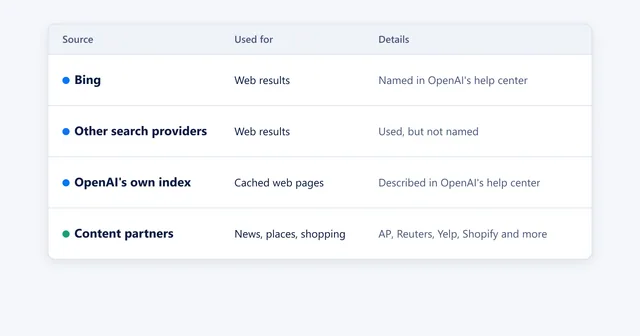
Both assistants search the live web, cite sources and run their own crawlers, but they lean on different providers. Claude's text search runs on Brave Search and the newer providers above. ChatGPT draws mainly on Bing, plus other search providers OpenAI doesn't name, partner content and its own index. Our companion guide on what search engine ChatGPT uses covers the evidence on OpenAI's side.
Frequently asked questions
Does Claude use Google Search?
There's no evidence it does. Google isn't on Anthropic's list of web search providers, which names Brave Search, TurboPuffer and Parallel Web Systems, and Anthropic's help center says Claude's image results come from Bing.
Does Claude use Bing?
For images, yes. Anthropic's help center says image search in Claude is powered by Bing. Its text web search runs on the providers on Anthropic's subprocessor list: Brave Search, TurboPuffer and Parallel Web Systems.
Can Claude search the web for free?
Yes. Web search launched for paid US users in March 2025 and has been available on all Claude plans worldwide since May 27, 2025. In Claude's newer interface it searches automatically when a question needs current information.
How do I stop Claude from using my website?
Use robots.txt. Block ClaudeBot to keep your content out of training, Claude-SearchBot to keep it out of Anthropic's search index, and Claude-User to stop fetches when a user asks Claude about your page. Blocking the last two can make your site less visible in Claude's answers.
Share
X (opens in a new tab)LinkedIn (opens in a new tab)WhatsApp (opens in a new tab)Akif Qureshi has worked in SEO for more than two years, auditing sites, planning content and tracking how Google updates change real traffic. He started SERP Times to report search changes clearly and to say exactly what site owners should do about them.
Certifications
- Google Analytics (Google)
- Google Ads Search (Google)
- HubSpot
- Digital Vidya
- DSIM
- Internship Studio