
Google UpdatesNews
Google December 2026 Core Update: What's Pre-Announced
For the first time, Google announced a core update before it started. The December 2026 core update isn't live yet. Here's what Google confirmed and what to do before it lands.

By Akif Qureshi
Published 9 min read
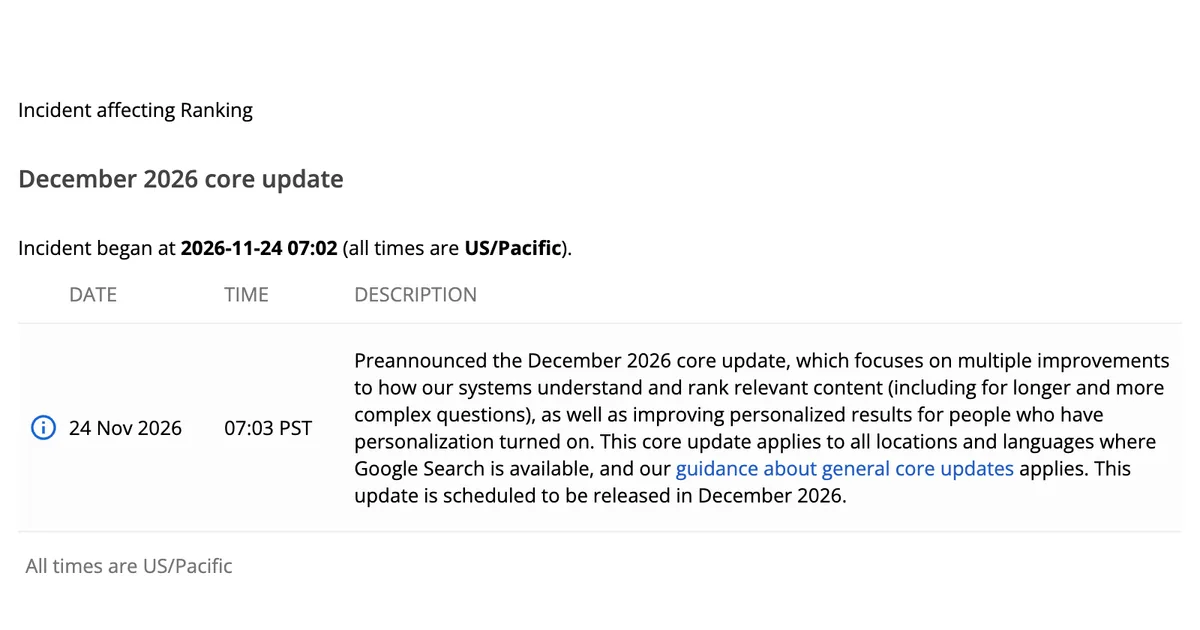
The December 2026 core update is the first core update Google has announced before it starts. Google posted it on its Search Status Dashboard on Nov 24, 2026 at 7:03 AM PT (10:03 AM ET), and said the update is scheduled for release in December 2026. It is not live yet, and Google hasn't given a start date.
This report covers what Google confirmed, what it left open, why it gave advance notice this time, and what US site owners can do before the rollout begins. We'll update it when Google posts a start date.
Key takeaways
What Google has confirmed
The dashboard entry is one paragraph. This is everything it says, as of Nov 26, 2026:
| Detail | What Google says |
|---|---|
| Name | December 2026 core update |
| Posted | Nov 24, 2026 at 7:03 AM PT (10:03 AM ET), labeled "Preannounced" |
| Focus | How its systems understand and rank relevant content, including for longer and more complex questions |
| Personalization | Improves personalized results for people who have personalization turned on |
| Scope | All locations and languages where Google Search is available |
| Guidance | Google's general core update guidance applies |
| Release | Scheduled for December 2026. No date given. |
Source: Google Search Status Dashboard, accessed Nov 26, 2026.
Two details make this different from past core updates. First, Google described what the update is about. Most core update announcements say only that it's a broad update and give a rollout estimate. Second, Google named a specific group of searchers: people who have personalization turned on.
It isn't live yet
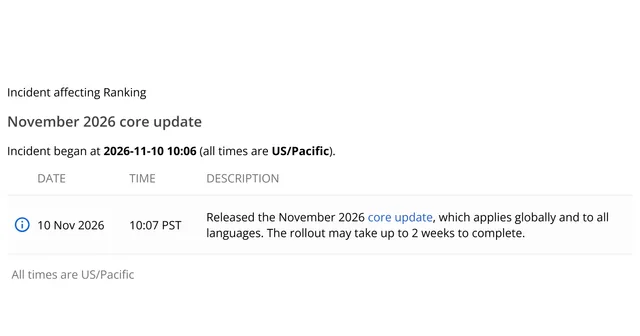
The dashboard lists the entry as an incident that "began" on Nov 24, which makes it look active. It isn't. A Google spokesperson told Search Engine Roundtable, "We don't have a date yet," said Google will announce the rollout on the day it starts, and added that it's "not imminent." The outlet said Google confirmed three times that the update is not live (Search Engine Roundtable, Nov 24, 2026).
So if your rankings moved between Nov 24 and the official start date, the December update isn't the cause. The November 2026 core update finished at 6:03 AM PT (9:03 AM ET) on Nov 24, an hour before the pre-announcement, after 13 days and 20 hours. Late effects of that rollout, holiday demand and Google's smaller, unannounced changes are more likely explanations.
Why Google announced it early
On the same day, Google published a new page, How to stay informed on Google Search ranking updates. It says Google now gives notice when an update brings actionable policy requirements or "may cause broad ranking shifts for site owners," and it names core updates as an example of the second kind.
The same page ties this to the UK. For changes where UK users may see a significant ranking shift, Google says it gives advance notice "in accordance with CMA's fair ranking conduct requirements." The CMA is the UK's Competition and Markets Authority.
What this means for US readers: the rule comes from the UK, but the December 2026 core update applies everywhere, and the pre-announcement is on the same public dashboard everyone uses. You get the same warning as UK publishers. Google hasn't said whether it will pre-announce every future core update, or how much notice it will give. Search Engine Journal reports that the CMA rules call for 15 or 30 business days of notice depending on the type of change, but Google's own page doesn't give a number of days (Search Engine Journal, Nov 24, 2026).
The new page belongs to a ranking hub on Search Central. Google also added pages on its ranking principles and on submitting feedback about ranking changes, which we cover below.
What "longer and more complex questions" could mean for your site
Google didn't explain this part, so what follows is our reading, not Google's.
People type longer, more specific searches than they used to, and AI Mode encourages full questions with several conditions ("best CRM for a 10-person roofing company in Texas that works with QuickBooks"). An update aimed at those searches should reward pages that answer the whole question, not just the head term.
You can see how your site does on those searches today. In Search Console:
- Open Performance → Search results and set the date range to the last 3 months.
- Add a filter: Query → Custom (regex) → Matches regex, and enter
^\S+(\s+\S+){7,}$. This keeps queries of eight words or more. - Add a Country filter for United States.
- Sort by impressions and look at the pages that show up.
Ask of each page: does it answer the full question in the query, with the specifics the searcher included (budget, location, size, tool, constraint)? Or does it answer a shorter, more general question? If you want to go further on question-style queries, our guide on how to get cited by ChatGPT covers writing answers that stand on their own.
What "personalized results" means
Google's Search Help explains that when signed-in users have Personalized Recommendations turned on, Google can use their Search activity to adjust results. Sometimes it changes the order of results, and sometimes the order of content blocks (for example, videos above web pages for someone who often watches videos). Signed-out users have a separate setting called Search customization (Google Search Help).
You can tell which you're seeing. A personalized results page says "Results are personalized" at the bottom, and a Try without link shows the same search without personalization.
Two practical points follow. These are our suggestions, not Google's:
- Rank trackers and Search Console may disagree more. Most rank-tracking tools check results without a signed-in history. Search Console reports what real users saw, personalized or not. If the update changes personalized results, expect a bigger gap between the two. Trust Search Console for traffic and positions.
- Check your own results with Try without. When you search for your keywords while signed in, you may be seeing a personalized page. Click Try without, or use a private window, before you decide your rankings changed.
How it compares with recent core updates
Google has released a core update in December in each of the last two years. The Search Status Dashboard's Ranking history shows:
| Core update | Started | Length |
|---|---|---|
| December 2024 | Dec 12, 2024 | 6 days, 4 hours |
| December 2025 | Dec 11, 2025 | 18 days, 2 hours |
| March 2026 | Mar 27, 2026 | 12 days, 4 hours |
| May 2026 | May 21, 2026 | 11 days, 21 hours |
| November 2026 | Nov 10, 2026 | 13 days, 20 hours |
| December 2026 | Not started | Scheduled for December 2026 |
Source: Google Search Status Dashboard, Ranking history, accessed Nov 26, 2026.
If the December 2026 update starts mid-month and runs as long as the last few, it could still be rolling out over Christmas and finish around the new year. That's an estimate from past patterns, not a Google date. It would also be the second core update in about a month, so check dates carefully when you assign a change to one update or the other.
You can follow every confirmed update, with dates, in our Google Update Tracker.
What to do before the rollout
- Save a baseline now. In the Search Console Performance report, filter to the United States and export your top pages and queries for a recent clean week. Late November is distorted by Thanksgiving, Black Friday (Nov 27) and Cyber Monday (Nov 30), so also keep a pre-holiday week, such as Nov 1 to Nov 7, 2026, for comparison. Search Console shows dates in Pacific Time.
- Separate the November and December updates. If you saw changes during Nov 10 to Nov 24, measure them now, a week after the November rollout finished. Otherwise they'll blur into December's.
- Review pages that target long, specific questions. Use the regex filter above and improve answers that skip the details searchers asked about.
- Don't make quick fixes. Google's core update guidance still applies: avoid quick fixes, don't change content that already performs well, and treat deleting content as a last resort.
- Plan around the holidays. For retailers, a ranking change during December costs more than in a slow month. Keep a gift guide or a seasonal category page stable during the rollout, and watch it daily in Search Console so you see any problem early.
- Subscribe to the dashboard. Google says it posts pre-announcements, start dates and completion notices on the Search Status Dashboard, which has an RSS feed.
If you lose traffic after it finishes
Google's new feedback page adds a way to report problems with a specific update. Once Google posts a significant ranking change on the dashboard, verified site owners can click Submit Feedback in Search Console and include the update's hashtag. Google's example is #NovemberCoreUpdate2026 for the November update. The December entry doesn't show a hashtag yet, so check the dashboard once the rollout starts.
Google suggests including:
- a snapshot of the Performance report
- the exact queries, country and language
- your affected URLs, and competing URLs that seem to rank poorly (such as scraped copies outranking the original)
- when and how your URLs were affected
- why the current results fail searchers, with before-and-after impressions or positions
Set expectations: Google says engineering teams review feedback in aggregate to find systemic issues, and it "doesn't result in manual ranking adjustments for individual URLs." For a large, sustained drop, the main work is still a fair review of your site against Google's guidance on helpful, reliable, people-first content.
What Google hasn't said
Google has not said:
- the start date, beyond "December 2026"
- how long the rollout will take
- what "longer and more complex questions" covers, or whether AI Overviews and AI Mode are part of it
- how the personalization changes work, or what share of searches they affect
- whether it will pre-announce future core updates, and with how much notice
Early "winners and losers" posts can't show anything until the rollout begins. Treat them with caution until Google posts a start date.
Update log
- Nov 26, 2026: Published two days after the pre-announcement. We'll add the start date when Google posts it, and the end date when the rollout is complete.
Sources
All accessed Nov 26, 2026.
- Google Search Status Dashboard: December 2026 core update, November 2026 core update and Ranking history.
- Google Search Central: How to stay informed on Google Search ranking updates, Submit feedback about ranking changes and Google Search's core updates and your website.
- Google Search Help: Personalization & Google Search results.
- Search Engine Roundtable: Google December 2026 core update preannounced, Nov 24, 2026.
- Search Engine Journal: Google documents advance notice for significant ranking updates, Nov 24, 2026.
Frequently asked questions
When does the December 2026 core update start?
Google hasn't given a date. The dashboard says only that it is scheduled for December 2026, and a Google spokesperson told Search Engine Roundtable it is "not imminent" and will be announced on the day it starts rolling out.
Is the December 2026 core update live now?
No. The dashboard entry looks like an active incident, but it is a pre-announcement. Google told Search Engine Roundtable several times that the update is not live and not active. Ranking changes you see before the official start date have another cause.
Does the update affect sites in the United States?
Yes. Google says it applies to all locations and languages where Google Search is available, which includes US English results.
What does "personalization turned on" mean?
It refers to signed-in Google users who have Personalized Recommendations turned on, so Google can use their Search activity to adjust results. Those users see "Results are personalized" at the bottom of the results page. Signed-out users have a separate setting called Search customization.
Should I change my content before the update?
Not in a rush. Google's guidance for core updates still applies: avoid quick fixes and don't change pages that already perform well. Use the time before the rollout to save a baseline in Search Console and to review pages that answer long, specific questions.
Share
X (opens in a new tab)LinkedIn (opens in a new tab)WhatsApp (opens in a new tab)Akif Qureshi has worked in SEO for more than two years, auditing sites, planning content and tracking how Google updates change real traffic. He started SERP Times to report search changes clearly and to say exactly what site owners should do about them.
Certifications
- Google Analytics (Google)
- Google Ads Search (Google)
- HubSpot
- Digital Vidya
- DSIM
- Internship Studio