
AI SearchGuide
How to Get Cited by ChatGPT: A Practical Checklist
ChatGPT can only cite pages its search crawler can reach. Here's what OpenAI actually documents, what industry studies add, and a 10-step checklist to follow this week.

By Akif Qureshi
Published 11 min read
On this page
The short answer to how to get cited by ChatGPT: let OpenAI's search crawler reach your pages, answer real questions near the top of each page with facts other sites don't have, and get your brand mentioned on the sites ChatGPT already cites. This checklist separates what OpenAI has documented from what industry studies suggest, then shows how to check each step and measure the result.
Key takeaways
How does ChatGPT find and cite sources?
ChatGPT doesn't search the web for every message. OpenAI's help page on searching the web with ChatGPT says it may search automatically when a question would benefit from current information, and users can also start a search from the tools menu. Web search is available on every plan, from Free and Go to Enterprise, and to people who aren't signed in.
Answers that use search can include citations in the text and a Sources panel. That's the placement you're after. Where do the sources come from? OpenAI shares the outline, not the detail:
- When it launched ChatGPT search in October 2024, OpenAI said it draws on third-party search providers and on content supplied directly by partners, and named publisher partners such as Associated Press, Reuters and the Financial Times. The same post says any website or publisher can choose to appear.
- The help page explains that ChatGPT rewrites a prompt into one or more targeted queries, sends them to its search providers, and may follow up with more specific queries. The only providers it names are Microsoft and Shopify, whose privacy policies it links to.
- OpenAI also runs its own search crawler, OAI-SearchBot.
On ranking, the help page says only that ChatGPT weighs several factors to find relevant, reliable information, and that "placement is not guaranteed". OpenAI doesn't publish those factors, so everything below beyond crawler access is informed practice, not a documented rule.
Which OpenAI crawlers matter for citations?
OpenAI's crawler documentation lists four user agents, and each is controlled separately in robots.txt.
| User agent | What OpenAI says it does | What blocking it does |
|---|---|---|
| OAI-SearchBot | Crawls pages so they can appear in ChatGPT search results | Your pages stop appearing in ChatGPT search answers, though they can still show as navigational links |
| GPTBot | Crawls content that may be used to train OpenAI's foundation models | Tells OpenAI not to use your content for training; search is unaffected |
| ChatGPT-User | Visits a page when a user's request in ChatGPT or a custom GPT needs it | Little: OpenAI says robots.txt may not apply to these user-initiated visits, and they don't decide search inclusion |
| OAI-AdsBot | Checks landing pages submitted as ChatGPT ads | Only matters if you advertise; it visits submitted ad pages only and isn't used for training |
Two details from the same page matter in practice. If you allow both OAI-SearchBot and GPTBot, OpenAI may use one crawl for both purposes. And after you change robots.txt, it can take about 24 hours for ChatGPT search to catch up.
To stay eligible for citations while opting out of training, add this to robots.txt:
User-agent: OAI-SearchBot
Allow: /

User-agent: GPTBot
Disallow: /
If you're happy for your content to be used in training too, change the GPTBot rule to Allow: /, or leave GPTBot out as long as no User-agent: * rule blocks everything.
robots.txt isn't the only gate. OpenAI's help page asks site owners to confirm that their host or content delivery network (CDN) lets through traffic from its published search bot IP addresses. Firewalls and bot protection can block OAI-SearchBot even when robots.txt allows it. Cloudflare, for example, began blocking AI crawlers by default for new customers in July 2025, as Search Engine Roundtable reported, so check your CDN's AI crawler settings.
To keep a page out completely, use a noindex meta tag rather than a robots.txt block. OpenAI's now-retired publisher FAQ noted that its crawler has to be allowed onto a page to read that tag.
What makes a page more likely to be cited?
OpenAI documents access, not ranking. Its help page does tell users how to judge a cited source: open it, check when it was published or updated, and prefer an authoritative source when accuracy matters. Make all three easy on your pages.
Independent research adds patterns, not rules:
- Fresh, genuinely updated pages. An Ahrefs study of about 17 million citations (July 2025) found that AI assistants cited pages 25.7% newer on average than those in Google's organic results. ChatGPT showed the strongest preference: its citations were 458 days newer than organic results. The average cited page was still 2.9 years old, and the study notes that Google's John Mueller has warned against changing dates without changing content.
- Facts, figures and sources. The GEO research paper from Princeton University and IIT Delhi (KDD 2024) found that adding quotations, statistics and links to sources raised a page's visibility in AI-generated answers by up to 40% in the authors' tests, while keyword stuffing made it worse. It tested a GPT-3.5-based engine of its own and Perplexity, not ChatGPT.
- Content in the HTML. A December 2024 analysis by Vercel found that none of the major AI crawlers, OpenAI's included, ran JavaScript, so text that only appears after scripts run may be invisible to them.
- Rankings help, but aren't everything. In Ahrefs' analysis of ChatGPT's 1,000 most-cited pages for September 2025, 28.3% had no organic Google keywords at all. Of those that did rank, 65.3% sat on domains with an Ahrefs Domain Rating of 81 or more.
- Structured data. OpenAI hasn't said ChatGPT reads schema markup. Microsoft's Fabrice Canel said in March 2025 that schema helps Microsoft's own LLMs understand content, according to Search Engine Roundtable. As Microsoft is one of the search providers OpenAI names, accurate markup is a reasonable, low-cost bet.
Signals that help, and how to check them
| Signal | Why it helps | How to check |
|---|---|---|
| OAI-SearchBot allowed | Required for ChatGPT search, per OpenAI | Our robots.txt and sitemap checker |
| OpenAI IPs not blocked | OpenAI asks hosts and CDNs to allow them | Firewall and bot settings; OAI-SearchBot in server logs |
| Main content in the HTML | AI crawlers didn't run JavaScript in Vercel's tests | View source (Ctrl+U) and search for a sentence |
| Answer-first sections | A passage that answers the question on its own | Do the first two sentences under each heading answer it? |
| Original data | Statistics and quotations helped in the GEO study | A number, test or example no other site has |
| Visible, honest dates | Ahrefs found ChatGPT cites newer pages than Google ranks | Updated date shown, and the content really changed |
| Named author with credentials | OpenAI tells users to prefer authoritative sources | Byline, author page and Article schema match |
| Structured data that matches the page | Helps search engines that feed AI answers | Google's Rich Results Test or Schema Markup Validator |
| Indexed by Bing | Microsoft is a search provider OpenAI names | Bing Webmaster Tools URL inspection |
| Mentions on sites ChatGPT cites | Wikipedia, review and media sites lead citation studies | Run your test prompts and list cited domains |
The checklist: 10 steps to follow this week
- Check robots.txt. Use our robots.txt checker to confirm OAI-SearchBot isn't blocked, either by name or by a
User-agent: *rule. Decide on GPTBot separately. - Check your CDN and firewall. Make sure bot protection doesn't challenge OpenAI's published IP ranges, then look for OAI-SearchBot in your logs a day or so later.
- Test the raw HTML. View the source of a key page and search for a sentence from the main text. If it's missing, ask your developer about server-side rendering or static generation.
- List the questions your customers ask. Write 10 to 20 prompts a buyer might type, such as "best accounting software for small businesses in India" or "how to file GST returns online", and map each to the page that should answer it.
- Rewrite each page's opening. Put the answer in the first two or three sentences, use question-style H2s, and use lists or tables for steps and comparisons.
- Add something only you have: your own prices, test results, survey numbers, screenshots or worked examples, with links to your sources.
- Show who wrote it and when. Add a byline linked to an author page with real credentials, plus a visible updated date that changes only when the content does.
- Add structured data. Use our schema generator for Article and FAQPage markup, plus Organization on your home page. Mark up only what's visible, and validate it.
- Make sure Bing can index you. Verify your site in Bing Webmaster Tools and submit your sitemap. In the same March 2025 talk, Canel recommended IndexNow for pushing new and updated URLs.
- Run your prompts and record a baseline. Note which sites ChatGPT cites for each one. Those domains become your outreach list.
How do you get mentioned on sites ChatGPT already cites?
Your own pages are only part of the picture. In Profound's analysis of ChatGPT citations from August 2024 to June 2025, Wikipedia made up 47.9% of citations among ChatGPT's ten most-cited domains and Reddit 11.3%, followed by Forbes, G2, TechRadar and NerdWallet. Those shares are within the top ten only, not of all citations.
Ahrefs found that about two-thirds of ChatGPT's top 1,000 cited pages were hard to influence (Wikipedia, home pages, app store listings); the rest were educational content, reviews, news and blogs. Its advice: find the publications and review sites ChatGPT cites in your market, then pitch them.
In practice:
- Digital PR. Give journalists and bloggers in your niche something worth citing: original data, an expert comment or a free tool. Prioritise the sites ChatGPT already cites for your topic.
- Reviews. For software and services, review sites such as G2 rank among ChatGPT's most-cited domains in Profound's data. Ask real customers for reviews on the platforms your buyers use.
- Reddit and forums. Reddit's share of citations is a reported pattern, not an invitation to spam. Answer questions in communities where you're a genuine member, follow each community's rules and disclose your affiliation.
- Wikipedia. Don't write or edit your own article: Wikipedia's conflict-of-interest guideline tells people to generally refrain from it. Brands get there through independent coverage.
Location matters too. OpenAI says ChatGPT may share your approximate location with its search providers, so a prompt run in Mumbai can cite different sites from one run in London. If your customers are in India, test from India and pitch the Indian sites that come up.
How do you measure ChatGPT citations and traffic?
ChatGPT citations don't appear in Search Console, so combine these sources:
- GA4. Google Analytics has an AI Assistant default channel for visits from ChatGPT, Gemini, Copilot and similar tools. If your property doesn't show it yet, set the dimension to Session source and look for
chatgpt.com. Our guide on how to increase website traffic walks through the report. - The UTM tag. OpenAI's publisher FAQ for its Atlas browser, retired along with Atlas, said ChatGPT adds
utm_source=chatgpt.comto referral links. Seer Interactive's testing found the tag mostly on cited sources rather than every link, and visits with neither a tag nor a referrer show up as Direct. - Server logs. A ChatGPT-User visit means ChatGPT fetched your page for someone's request. Check claimed OpenAI visits against the published IP lists, because anyone can fake a user agent.
- Manual prompt tests. Rerun your prompts monthly and log whether you're cited, which page and which competitors appear. OpenAI says saved memories and location can shape the searches ChatGPT runs, so use a Temporary Chat (choose unpersonalised if offered) or a logged-out window.
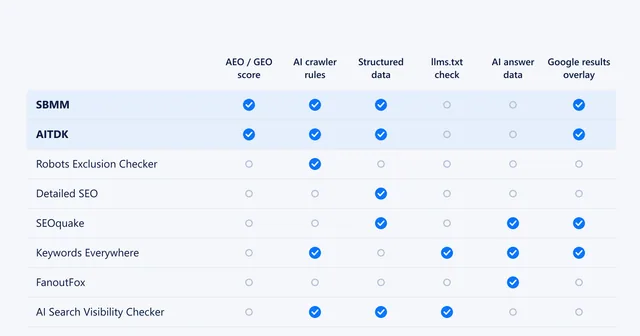
- Tracking tools. Our roundup of SEO Chrome extensions covers FanoutFox, which shows the searches ChatGPT ran and the sources it fetched and cited. Paid tools such as Ahrefs Brand Radar track citations across many prompts.
Do you need an llms.txt file for ChatGPT?
No. llms.txt is a proposal by Jeremy Howard from September 2024: a Markdown file at your site's root that gives AI tools a short overview of the site with links to key pages. OpenAI publishes one for its own developer documentation, but its crawler documentation doesn't mention the file, and OpenAI hasn't said ChatGPT search reads it.
It's cheap and harmless to add, but it won't fix a blocked crawler or a page whose text only loads with JavaScript.
Common mistakes that stop ChatGPT citing you
- Blocking OAI-SearchBot by accident. A blanket
Disallow: /underUser-agent: *, a security plugin or a CDN bot rule can all do it. - Paying for "guaranteed" ChatGPT placement. OpenAI says placement isn't guaranteed, and ads don't buy answers.
- Hiding the answer. Long introductions, answers inside images, or text in tabs that load with JavaScript give ChatGPT less to quote.
- Judging one result. Answers vary by day and location, so track the same prompts over time.
Frequently asked questions
Does ChatGPT use Google or Bing results?
OpenAI says ChatGPT search uses third-party search providers plus content from its partners, and its help page names Microsoft, which owns Bing, and Shopify as providers whose privacy policies apply. It doesn't publish a full list or say that it uses Google. OpenAI also runs its own crawler, OAI-SearchBot, so allow that and make sure Bing can index your site.
How long does it take to get cited by ChatGPT?
OpenAI gives no timeline. The only figure it publishes is that robots.txt changes take about 24 hours to reach ChatGPT search. ChatGPT searches the web live, so a crawlable page that answers a prompt well can be cited soon after it's found, but earning mentions on other sites takes longer. Rerun the same prompts monthly and judge your changes over a few months.
Can I pay to be cited in ChatGPT?
No. OpenAI says ads don't influence ChatGPT's answers, run on separate systems from the chat model, and give advertisers no way to shape or rank responses. Ads appear separately and labelled, below answers, for Free and Go users. Advertisers based in India can buy them through self-service Ads Manager, but an ad is not a citation.
Should I block GPTBot?
It's your choice, and it doesn't affect ChatGPT search. Blocking GPTBot tells OpenAI not to use your content to train its models; search inclusion is controlled by OAI-SearchBot. Block GPTBot if you publish paid or exclusive content you don't want in training data. If you allow both bots, OpenAI may use one crawl for both purposes.
Share
X (opens in a new tab)LinkedIn (opens in a new tab)WhatsApp (opens in a new tab)Akif Qureshi has worked in SEO for more than two years, auditing sites, planning content and tracking how Google updates change real traffic. He started SERP Times to report search changes clearly and to say exactly what site owners should do about them.
Certifications
- Google Analytics (Google)
- Google Ads Search (Google)
- HubSpot
- Digital Vidya
- DSIM
- Internship Studio