
MarketingGuide
ROAS vs ROI: Formulas, Examples and Break-Even ROAS
ROAS tells you how much revenue each ad dollar brought in. ROI tells you whether you made money. Here's how to calculate both, why a 4x ROAS can still lose money, and how to find the ROAS your margin needs.

By Akif Qureshi
Published 6 min read
On this page
The difference in ROAS vs ROI is what each one measures: ROAS divides the revenue your ads brought in by what the ads cost, while ROI divides the profit left after all marketing costs by those costs.
So ROAS answers "did the ads drive sales?" and ROI answers "did we make money?" A campaign can score well on the first and fail the second. This guide shows both formulas, works through examples in US dollars, and shows how to find your break-even ROAS: the one number that tells you whether a ROAS is good for your business.
Key takeaways
The two formulas
ROAS = revenue from the ads ÷ ad spend

ROI  = (revenue × profit margin − total marketing cost) ÷ total marketing cost × 100
ROAS uses only two numbers, which is why ad platforms report it. Google Ads expresses it as a percentage: its Target ROAS help page uses the example of $5 in sales for every $1 in ad spend, which it writes as a target ROAS of 500%. Elsewhere you'll see the same result written as 5, 5x or 5:1.
ROI needs three more things:
- Your profit margin before marketing: price minus what it costs you to make, ship and deliver the product, divided by the price. Revenue times margin is your gross profit.
- Every campaign cost, not just ad spend: agency or freelancer fees, creative, landing page software.
- One time window for both costs and revenue.
Some guides calculate marketing ROI as (revenue − cost) ÷ cost. That skips the margin, so it treats every sales dollar as profit and makes almost any campaign look profitable. Use the margin version.
| ROAS | ROI | |
|---|---|---|
| Measures | Revenue per ad dollar | Profit per marketing dollar |
| Inputs | Revenue, ad spend | Revenue, margin, all marketing costs |
| Usual format | Ratio (4x) or percent (400%) | Percent (21.7%) |
| Break-even | 1 ÷ margin | 0% |
| Best for | Comparing ads, setting bid targets | Deciding whether to spend more |
Worked example: a Black Friday Shopping campaign
Say you run a Shopify store that ships soy candles across the US. Your Black Friday Google Shopping campaign, running from November 27 to November 30, 2026, cost $4,000 in ads. Google Ads reports $16,000 in sales. You also paid a freelancer $600 for the product photos and feed setup. Your margin is 35%.
| Step | Calculation | Result |
|---|---|---|
| ROAS | $16,000 ÷ $4,000 | 4.0 (400%) |
| Gross profit | $16,000 × 35% | $5,600 |
| Total marketing cost | $4,000 + $600 | $4,600 |
| Net profit | $5,600 − $4,600 | $1,000 |
| ROI | $1,000 ÷ $4,600 × 100 | 21.7% |
A good result: the campaign paid for itself and left $1,000. Now change one thing. If your margin were 20% instead of 35%, gross profit drops to $3,200, and the same 4.0 ROAS gives a net loss of $1,400, an ROI of −30.4%. The ad platform would show the same ROAS both times.
Why a higher ROAS can mean a lower ROI
Margins differ between products, so ROAS can rank your campaigns in the wrong order. Two campaigns, each with $2,000 of ad spend and no other costs:
| Campaign A: gift sets | Campaign B: refill wax | |
|---|---|---|
| Revenue | $10,000 | $6,000 |
| ROAS | 5.0 | 3.0 |
| Margin | 20% | 60% |
| Gross profit | $2,000 | $3,600 |
| Net profit | $0 | $1,600 |
| ROI | 0% | 80% |
Judged by ROAS, A wins. Judged by profit, B made $1,600 and A made nothing. If you set one ROAS target across products with different margins, this is the trap.
Break-even ROAS: the number to know first
Break-even ROAS is the ROAS at which the profit from the sales exactly covers the ad spend:
Break-even ROAS = 1 ÷ profit marginAt a 35% margin, that's 1 ÷ 0.35 = 2.86. Below it, every sale costs you money once you pay for the ad that made it.
| Profit margin | Break-even ROAS | As a Google Ads percentage |
|---|---|---|
| 20% | 5.00 | 500% |
| 25% | 4.00 | 400% |
| 30% | 3.33 | 333% |
| 40% | 2.50 | 250% |
| 50% | 2.00 | 200% |
| 60% | 1.67 | 167% |
| 80% | 1.25 | 125% |
That formula covers the ad spend only. To cover your other campaign costs as well, divide the total marketing cost by the ad spend times the margin. In the candle example: $4,600 ÷ ($4,000 × 0.35) = 3.29. The campaign's 4.0 cleared both bars, which is why it made money.
If you use Google Ads Target ROAS bidding, your break-even percentage is the floor. A target set below it tells Google to buy sales that lose money.
What a "good" ROAS depends on
You'll find "good ROAS" benchmarks all over the web, usually without a source or a margin attached. They can't apply to you without knowing these four things:
- Your margin. The table above is the biggest factor. A software company with an 80% margin profits at a ROAS a furniture retailer couldn't survive on.
- Your other costs. Agency fees, creative and tools raise the bar above 1 ÷ margin.
- How revenue is counted. Google Ads, Meta and GA4 each credit sales by their own attribution rules, and two platforms can both claim the same order. Pick one source of truth, such as your store's orders matched with GA4, and use it for every campaign. Our UTM link guide covers tagging the clicks so GA4 can match them.
- Repeat purchases. If customers you win on Black Friday keep buying, a first-order ROAS slightly under break-even can still pay off over a year. That's a judgment you make from your own repeat-purchase data, not a reason to ignore the math.
When to use each one
Use ROAS day to day: comparing ad groups, products or creatives inside one platform, and setting bid targets. It's fast and the platforms report it for you.
Use ROI for decisions about money: whether to raise a budget, renew an agency, or keep running a channel. Check it monthly or per campaign, with all the costs in.
Calculate both with our ROI calculator
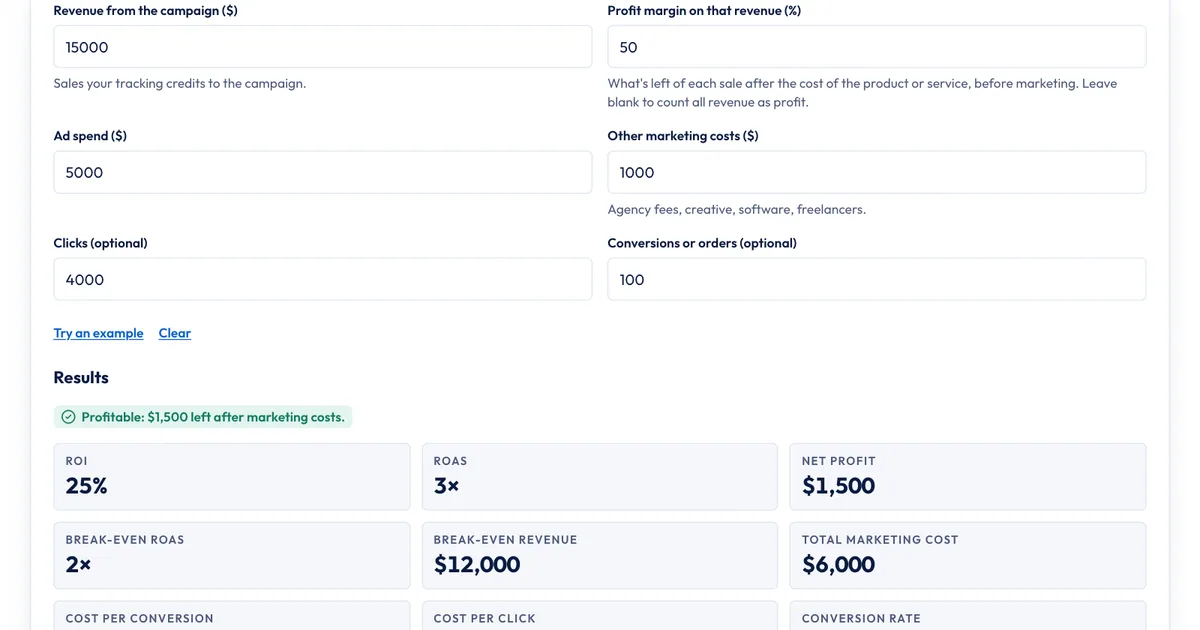
The free SERP Times marketing ROI calculator does all of the math above in one step, in US dollars:
- Enter Revenue from the campaign and Ad spend.
- Enter your Profit margin on that revenue and any Other marketing costs.
- Optionally add Clicks and Conversions or orders for cost per click, conversion rate and cost per conversion.
- Read the verdict, then the ROI, ROAS, Net profit, Break-even ROAS and Break-even revenue.
Enter the candle example and you'll see ROI 21.7%, ROAS 4×, break-even ROAS 2.86× and break-even revenue of $13,143. If you leave the margin blank, the calculator counts all revenue as profit and tells you so, which flatters the result.
What it doesn't do: it doesn't pull data from your ad accounts, fix attribution or model repeat purchases. Its break-even ROAS is 1 ÷ margin (ad spend only); the break-even revenue figure is the one that includes your other costs. For a single campaign or a monthly check, that's enough. If you run many channels and need attribution across them, you'll want reporting that joins your ad platforms with your order data.
Sources
All accessed Nov 20, 2026:
- Google Ads Help: About Target ROAS bidding
The formulas and worked examples are standard arithmetic; every number in the tables is calculated from the inputs shown, rounded to one or two decimal places.
Frequently asked questions
Is ROAS a percentage or a ratio?
Both are used for the same number. $5 of revenue from $1 of ad spend is a ROAS of 5, 5x, 5:1 or 500%. Google Ads uses the percentage for Target ROAS bidding, while most ecommerce reports use the ratio. Just don't compare a 500% ROAS with a 500% ROI: they measure different things.
What is ROMI?
Return on marketing investment. It's ROI applied to marketing spend: the profit a campaign produced after its marketing costs, divided by those costs. The ROI formula in this guide is a ROMI calculation.
Should ROI include the cost of goods sold?
Yes, through your margin. Revenue isn't profit until you subtract what the products or services cost you to deliver. Multiplying revenue by your profit margin does that, and then you subtract the marketing costs.
Where do I find ROAS in Google Ads?
Add the Conv. value / cost column to your campaigns table. It shows conversion value divided by cost, which is ROAS as a ratio. Multiply by 100 for the percentage that Target ROAS bidding uses. It's only as accurate as the conversion values you send to Google Ads.
Share
X (opens in a new tab)LinkedIn (opens in a new tab)WhatsApp (opens in a new tab)Akif Qureshi has worked in SEO for more than two years, auditing sites, planning content and tracking how Google updates change real traffic. He started SERP Times to report search changes clearly and to say exactly what site owners should do about them.
Certifications
- Google Analytics (Google)
- Google Ads Search (Google)
- HubSpot
- Digital Vidya
- DSIM
- Internship Studio