
SEOGuide
Keyword Stuffing: What Google Counts as Spam, With Examples
Google's spam policies define keyword stuffing as filling a page with keywords or numbers to manipulate rankings. Here's what that looks like, how to check your own pages and how to fix them.

By Akif Qureshi
Published 8 min read
On this page
Keyword stuffing is filling a web page with keywords or numbers in an attempt to manipulate its rankings, and Google's spam policies list it as a violation that can push a page lower in results or remove it entirely. It includes repeating the same phrase until the text sounds unnatural, blocks of city names a page wants to rank for, and lists of phone numbers that add nothing for the reader.
Besides the risk, a stuffed page reads badly to the people you want as customers. This guide shows what Google counts as keyword stuffing, real-world examples, what happens to stuffed pages, and how to check and fix your own.
Key takeaways
How Google defines keyword stuffing
Google's spam policies describe keyword stuffing as "the practice of filling a web page with keywords or numbers in an attempt to manipulate rankings in Google Search results." It adds that the keywords often appear in a list or group, unnaturally or out of context.
The policy gives three examples:
- Lists of phone numbers without substantial added value.
- Blocks of text that list cities and regions a page is trying to rank for.
- Repeating the same words or phrases so often that it sounds unnatural.
Google's SEO Starter Guide makes the same point from the reader's side: excessively repeating the same words, even in variations, is tiring for users, and keyword stuffing is against the spam policies.
The key word is intent. A guide to Medicare enrollment will say "Medicare" dozens of times because that's the subject. Stuffing is repetition that exists for a search engine, not for the person reading.
What keyword stuffing looks like
Repeated phrases in body text
This is the classic version. Here's a made-up example for a plumbing company in Texas:
Looking for an emergency plumber in Dallas? Our emergency plumber in Dallas team is the best emergency plumber in Dallas for any emergency plumber Dallas job. When you need an emergency plumber in Dallas TX, call the emergency plumber Dallas residents trust. We are your local emergency plumber in Dallas, Plano, Irving, Garland, Frisco, McKinney, Richardson, Mesquite, Carrollton and Grand Prairie.
It has two of Google's three examples in 61 words: a phrase repeated until it's unnatural, and a block of city names.
City and ZIP code lists
Local businesses do this most often: a footer or sidebar listing 40 suburbs or every ZIP code in a metro area, with no information about the service in any of them. If you really serve those areas, a service area page that explains where you go, your typical arrival times and any differences in pricing gives readers something useful. A bare list doesn't.
Phone numbers and number strings
Pages that list hundreds of phone numbers, product codes or model numbers with no other content fall under the first example in Google's policy.
Title tags, alt text and other hidden places
Stuffing isn't only in the visible text. Google's Manual Actions report help page tells site owners to look for repeated strings in <title> elements and in image alt text. A few examples:
- Title:
Cheap Flights | Cheap Airline Tickets | Cheap Flights to Orlando | Cheap Flights Deals - Alt text:
alt="running shoes best running shoes cheap running shoes running shoes sale"instead of a description of the photo. - Hidden text: white text on a white background, text pushed off-screen with CSS, or text with a font size of zero. These are covered by the hidden text part of the same spam policies.
Google's title link documentation adds that there's no reason to have the same words or phrases appear multiple times in a title.
The meta keywords tag
Stuffing the <meta name="keywords"> tag is a waste of time rather than a risk: Google's SEO Starter Guide says Google Search doesn't use the keywords meta tag.
What happens to pages with keyword stuffing
Google says it detects spam "through automated systems and, as needed, human review that can result in a manual action." Sites that break its policies "may rank lower in results or not appear in results at all."
There are two ways this can hit you:
- Automatically. Google's systems can rank a stuffed page lower without telling you. There's no notification, so you'll only see it as a drop in Search Console's Performance report.
- Through a manual action. A Google reviewer can apply a manual action called "Hidden text and/or keyword stuffing." You'll see it in Search Console's Manual Actions report and in the message center. After you fix every affected page, you click Request Review and wait for Google's answer, without resubmitting while the request is pending.
Is there a safe keyword density?
No. Keyword density is the share of a page's words taken up by one phrase, and Google has never published a target for it. Its spam policies, its SEO Starter Guide and its guidance on helpful content don't mention density at all.
You'll still find guides that recommend 1% to 2%, or a "safe range" of 2% to 5%. None of them cite a Google source, and the math shows why a fixed number can't work. Here's a rewrite of the plumbing paragraph above:
A burst pipe at 2 AM can flood a kitchen in minutes. Our emergency plumbers answer the phone 24 hours a day and usually reach homes in Dallas within an hour. Before we arrive, shut off the main water valve. In most North Texas homes, it sits in a box near the street. We give you the price before we start, and nights and weekends cost the same as weekdays.
We ran both versions through our Keyword Density Checker:
| Stuffed version | Rewrite | |
|---|---|---|
| Total words | 61 | 70 |
| "emergency plumber(s)" | 7 times, 22.95% | 1 time, 2.86% |
| "plumber in dallas" | 5 times, 24.59% | 0 times |
| Most-repeated two-word phrase | "emergency plumber," 7 times | none repeats |
The rewrite uses its main phrase exactly once, and that single natural use already comes to 2.86% of a 70-word text, above a "2% rule." In a 2,000-word guide, the same single use would be 0.1%. Density depends on length, so it can't tell you whether a page is stuffed. Reading it can.
How to check your pages for keyword stuffing
- Read the page aloud. If a phrase sounds forced or repetitive when spoken, it is. This catches more than any tool.
- Run the text through a density checker to see which phrases you repeat most. Our Keyword Density Checker shows one-, two- and three-word phrases with counts and percentages. Use it to find repetition you didn't notice, not to hit a number.
- Check the title, headings and alt text. Our On-Page SEO Checker pulls a live page's title, meta description, headings and image alt text into one view.
- Look for hidden text. In Search Console, the URL Inspection tool's live test shows the page as Googlebot renders it. Compare it with what a visitor sees, and select all the text on the page (Ctrl+A or Cmd+A) to reveal text colored like the background.
- Check templates. Footers, sidebars and location widgets repeat on every page, so one stuffed footer is stuffing on the whole site.
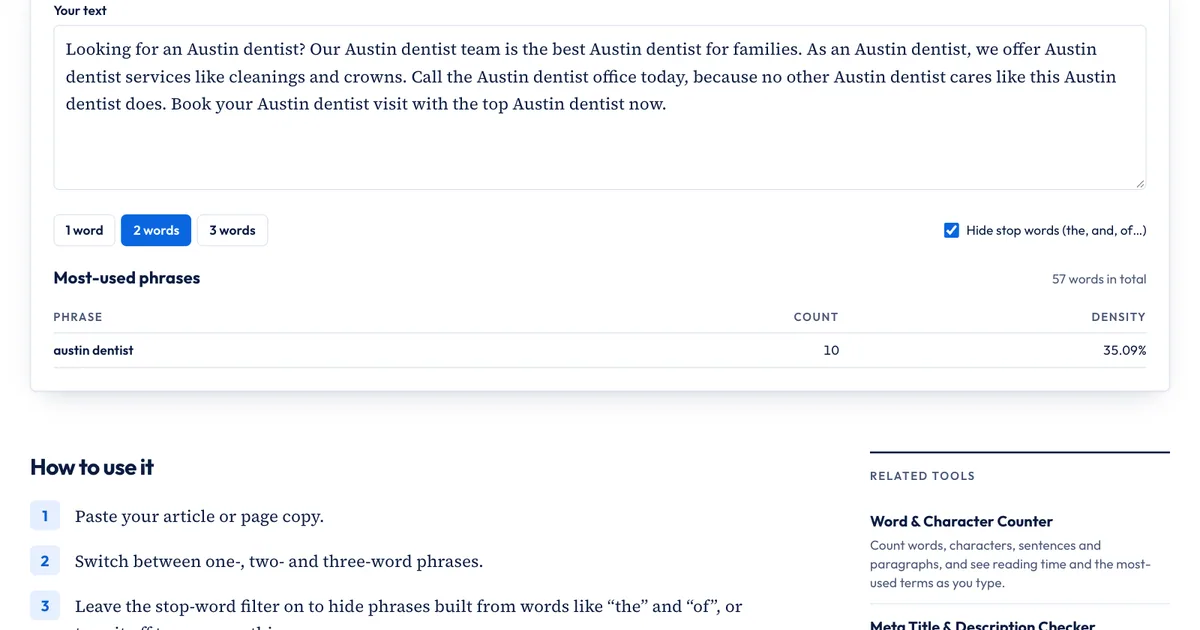
To use the Keyword Density Checker:
- Paste your page copy into the box.
- Switch between 1 word, 2 words and 3 words to see single terms and phrases.
- Leave Hide stop words on to skip phrases that start or end with words like "the" and "of," or turn it off to see everything.
- Look at the top of the list. If one phrase repeats far more than reads naturally, rewrite those sentences.
What it doesn't do: it analyzes the text you paste, not a live URL, and it can't see titles, alt text or hidden text. Its stop-word list is English only. And it doesn't give a pass or fail, because there's no density at which a page becomes spam.
How to fix keyword stuffing
- Rewrite repeated phrases. Use the main phrase where it's natural (often the title, the main heading and once early in the text), then use pronouns, synonyms and specifics. "Our plumbers," "we" and "the crew" read better than a fifth "emergency plumber in Dallas."
- Replace lists with content. Turn a list of 40 cities into a service area page that says how you serve those areas. If you have real, different information for a city, it may deserve its own page; if you'd just swap the city name, it doesn't.
- Fix titles and alt text. One clear title per page, written for the person choosing a search result. Alt text that describes the image, as you would to someone who can't see it.
- Remove hidden text completely, or make it visible if it's useful.
- Request a review if you had a manual action, once every affected page is fixed.
If you're unsure where your keyword belongs, our guides to meta title length and URL slugs cover two of the places it naturally goes, without repetition.
Sources
- Spam policies for Google web search, Google Search Central, accessed Nov 20, 2026.
- SEO Starter Guide, Google Search Central, accessed Nov 20, 2026.
- Manual Actions report, Search Console Help, accessed Nov 20, 2026.
- Influencing your title links in search results, Google Search Central, accessed Nov 20, 2026.
- Creating helpful, reliable, people-first content, Google Search Central, accessed Nov 20, 2026.
Frequently asked questions
Is using a keyword many times on one page always keyword stuffing?
No. A long guide about Google Analytics will name Google Analytics many times because that's the topic. It becomes stuffing when the repetition is there for search engines rather than readers and makes the text sound unnatural, or when it takes the form of lists of keywords, cities or phone numbers with no real content.
Are keyword variations and synonyms keyword stuffing?
No. Using different words for the same idea is what natural writing does. Google's SEO Starter Guide says varying your words, writing naturally so you aren't repetitive, gives you more chances to match how different people search.
How long does it take to recover after removing keyword stuffing?
Google doesn't give a timeline. If there was a manual action, Google reviews the site after you request a review, and you'll get the result in Search Console. Without a manual action, there's nothing to file: Google reassesses your pages as it recrawls them.
Share
X (opens in a new tab)LinkedIn (opens in a new tab)WhatsApp (opens in a new tab)Akif Qureshi has worked in SEO for more than two years, auditing sites, planning content and tracking how Google updates change real traffic. He started SERP Times to report search changes clearly and to say exactly what site owners should do about them.
Certifications
- Google Analytics (Google)
- Google Ads Search (Google)
- HubSpot
- Digital Vidya
- DSIM
- Internship Studio