
AI SearchNews
Gemini 4 Carbon: Benchmarks, Pricing and How to Use It
Google DeepMind released Gemini 4 Carbon on November 10, 2026, its strongest model for long, multi-step coding, research, cybersecurity and science. Here's what it can do, how it compares, what it costs and where you can use it.

By Akif Qureshi
Published 7 min read
Gemini 4 Carbon is Google DeepMind's newest and most capable Gemini model, released on November 10, 2026 to developers, businesses and Google AI Ultra subscribers, and built for long, multi-step work such as complex coding and debugging, deep research, cybersecurity and scientific analysis.
It sits above Gemini 4 Argon, which Google says remains the right choice for most everyday work. Carbon is for the hardest tasks: it uses more tokens to explore, reason and check its own work, and in Google's tests it beats rival frontier models on some benchmarks but not all. Here's what Carbon can do, how it compares, what it costs and where to try it, based on Google's launch post and DeepMind's model card, checked November 11, 2026.
Key takeaways
What is Gemini 4 Carbon?
Gemini 4 Carbon is built on Gemini 4 Argon, which Google released shortly before it. Google describes Carbon as its "strongest model" for "long-horizon agentic workflows," meaning tasks that take many steps and a long time, such as migrating a large codebase, analyzing a stack of financial documents or running a research project.
The trade-off is effort. Carbon uses more thinking tokens than Argon "to explore thoroughly, reason deeply, and run extended verification loops," and the model card warns of occasional slowness or timeouts at higher thinking levels. You can set the thinking level to balance quality, speed and cost. Google's own advice: use Argon for most software engineering and knowledge work, and Carbon when a task tests the limits of a model.
Google first gave Carbon to a group of cybersecurity defenders through its Fairwind Program two weeks before the general release.
Availability and pricing
| Who | Where to use it | Access |
|---|---|---|
| Developers | Gemini API, Google AI Studio, Android Studio | Paid API tier |
| Businesses | Gemini for business (API or model picker), Google Antigravity, CodeMender | Paid plans |
| Consumers | Gemini app, AI Mode in Google Search | Google AI Ultra subscribers |
| Scientists | Google Antigravity's highest usage tier | Free for six months, by application |
| Security teams | Carbon for cyber | By application to the Fairwind Program |
Through the API, Carbon costs $2 per million input tokens and $10 per million output tokens (as of November 11, 2026). Google calls this an introductory price, and it's the same as Argon's. Because Carbon uses more tokens per task, the same job can still cost more than on Argon; Google argues it's cheaper per task than rival frontier models, citing results on independent benchmarks run by Cursor, Perplexity and Zapier.
Specs at a glance
| Gemini 4 Carbon | |
|---|---|
| Based on | Gemini 4 Argon |
| Input | Text, images, audio and video |
| Output | Text |
| Context window | Up to 1 million tokens, input and output combined |
| Knowledge cutoff | March 2026 |
| Thinking levels | Configurable, to trade quality against speed and cost |
How Gemini 4 Carbon compares
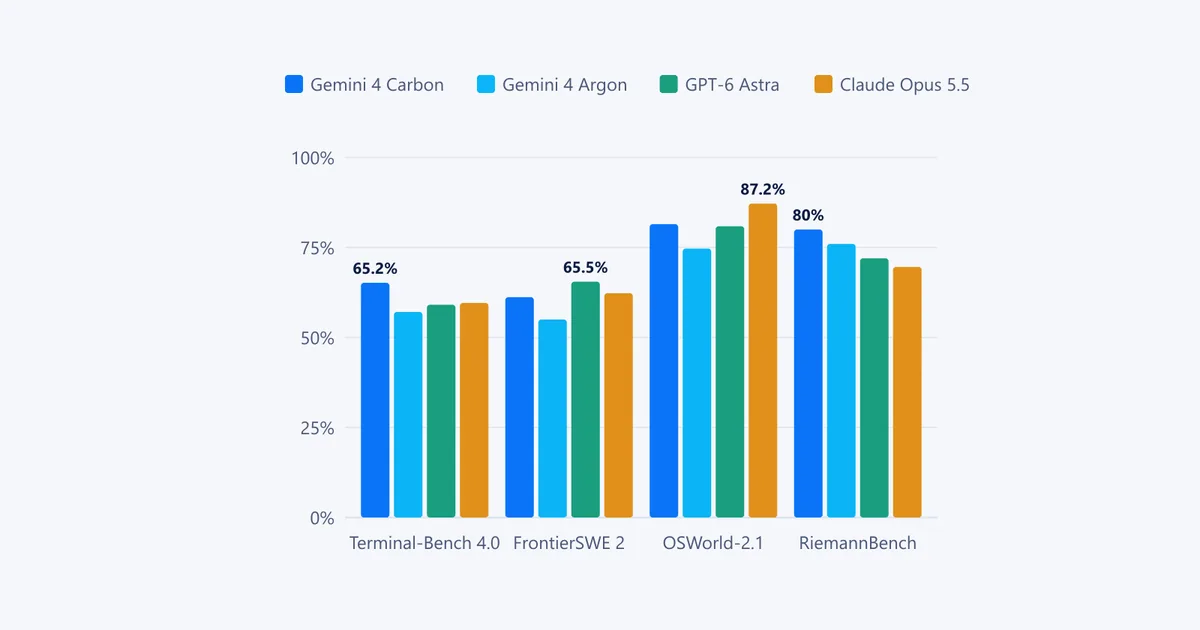
DeepMind's model card compares Carbon with Gemini 4 Argon, OpenAI's GPT-6 Astra and Anthropic's Claude Opus 5.5 and Claude Fable 5.1. A selection of those results, as of October 2026:
| Benchmark | What it tests | Gemini 4 Carbon | Gemini 4 Argon | GPT-6 Astra | Claude Opus 5.5 |
|---|---|---|---|---|---|
| Terminal-Bench 4.0 | Agentic coding in a terminal | 65.2% | 57.1% | 59.1% | 59.6% |
| FrontierSWE 2 | Real software engineering tasks | 61.2% | 55.0% | 65.5% | 62.3% |
| OSWorld-2.1 | Computer use | 81.5% | 74.7% | 80.9% | 87.2% |
| AutomationBench (Zapier) | Business automation | 53.9% | 51.3% | 41.4% | 42.5% |
| GraphWalks (256K–1M) | Long-context reasoning | 96.2% | 84.2% | 71.8% | 66.8% |
| RiemannBench | Math | 80.0% | 76.0% | 72.0% | 69.6% |
| SEC-bench Pro | Finding vulnerabilities | 88.2% | 83.4% | 85.4% | — |
These are Google's own numbers, and cybersecurity scores reflect Carbon when accessed through the Fairwind Program. They show a real step up from Argon and a lead on long-context and math tests, but no clean sweep: GPT-6 Astra scored higher on FrontierSWE 2, and Claude Opus 5.5 scored higher on computer use. Independent testing over the next few weeks will tell you more than any launch chart.
What's new in Gemini 4 Carbon
- Knowledge work. Carbon reads dense documents with charts, tables and blueprints and produces structured spreadsheets, presentations and reports. On a new Multimodal Knowledge Agent benchmark built with Artificial Analysis, Google says it ranked second at more than six times lower average cost per task than the leader.
- Coding and design. It handles multi-package migrations, root-cause investigations and full web apps, checking both its code and the rendered interface. A new
/swarmpreview in Google Antigravity turns one prompt into a team of agents, with Carbon assigned to the roles that need the deepest reasoning, such as architectural design, coordination and auditing. - Cybersecurity. Google says Carbon is its strongest cyber model yet. In its own scanning system, it reached 100% recall on scanning and 95% precision on triage on an internal benchmark, and security firm Wiz used it to find previously unknown vulnerabilities at two major SaaS providers in under two hours.
- Science. Google researchers used Carbon to help formally verify the code behind Signal's cryptographic protocol in weeks, and to find 40 times more related protein sequences for hard-to-predict protein families.
Safety
Because Carbon is stronger at cybersecurity, Google says it added tighter misuse safeguards. In simulated attack testing, Carbon blocked 99% of attack attempts from an adaptive red-teaming agent, and its per-attempt breach rate fell to 0.8%, from 3.1% on Argon. On Google's agentic honesty benchmark it passed 92% of tasks, compared with 70% for Argon, and it recorded a 0% attack success rate on the Gray Swan indirect prompt injection benchmark. Google adds that prompt injection "remains an area for continued improvement." The full results are in Google's Gemini 4 Carbon Safety and Security Report.
What it means for marketers and SEO teams
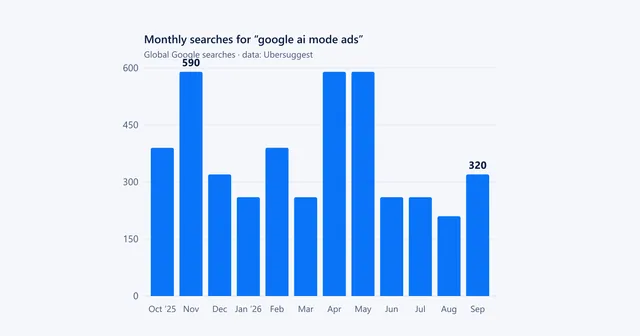
- AI Mode is getting a stronger model. Google AI Ultra subscribers can now use Carbon in AI Mode in Search, which means longer, more thorough research answers for those users. Pages with clear, specific, verifiable facts are the easiest for a model like this to cite. Our guide to Google AI Mode ads covers the paid side of AI Mode.
- Better analysis of your own data. Carbon's strengths in reading spreadsheets, charts and long documents suit work such as auditing a large site export, analyzing a year of GA4 data or comparing competitor pages, as long as you check its output.
- Watch the token bill. For routine tasks such as writing meta descriptions or summarizing a page, Argon or a lighter model will usually do the job for less.
- Knowledge stops in March 2026. For anything newer, such as recent Google updates, give it sources or use a version with search grounding; our Google Update Tracker lists every confirmed update.
How to try Gemini 4 Carbon
- In the Gemini app or AI Mode: it's rolling out to all Google AI Ultra subscribers, so look for Carbon in the model options once it reaches your account.
- As a developer: select Gemini 4 Carbon in Google AI Studio or call it through the paid tier of the Gemini API.
- At work: choose it in Gemini for business or Google Antigravity, if your organization's plan includes it.
- For research or security work: apply to Google's scientist access program or the Fairwind Program.
Frequently asked questions
How much does Gemini 4 Carbon cost?
Through the Gemini API, Gemini 4 Carbon costs $2 per million input tokens and $10 per million output tokens at its introductory price, the same as Gemini 4 Argon (as of November 11, 2026). It tends to use more tokens than Argon on the same task, so the cost per task can be higher. In the Gemini app and AI Mode, it's available to Google AI Ultra subscribers.
What's the difference between Gemini 4 Carbon and Gemini 4 Argon?
Carbon is built on Argon and uses more thinking tokens to explore, reason and check its work, which makes it stronger on the hardest coding, research, science and cybersecurity tasks. Google says Argon remains the better choice for most everyday software engineering and knowledge work.
Is Gemini 4 Carbon better than Claude or GPT-6?
On some tasks. In Google's own published results, Carbon led on benchmarks such as Terminal-Bench 4.0, RiemannBench and AutomationBench, while GPT-6 Astra led on FrontierSWE 2 and Claude Opus 5.5 led on OSWorld-2.1. Results from the model's maker are a starting point; test it on your own tasks.
What is Gemini 4 Carbon's knowledge cutoff?
March 2026, according to Google DeepMind's model card. For anything newer, it relies on tools such as Google Search grounding.
Share
X (opens in a new tab)LinkedIn (opens in a new tab)WhatsApp (opens in a new tab)Akif Qureshi has worked in SEO for more than two years, auditing sites, planning content and tracking how Google updates change real traffic. He started SERP Times to report search changes clearly and to say exactly what site owners should do about them.
Certifications
- Google Analytics (Google)
- Google Ads Search (Google)
- HubSpot
- Digital Vidya
- DSIM
- Internship Studio