
ToolsGuide
Daily Rank Tracker: Semrush, Ahrefs, SE Ranking, Ubersuggest
SE Ranking and Semrush check rankings every day; Ahrefs and Ubersuggest update weekly. Here's how much history each keeps, what it costs, and what a week of real tracking data shows.

By Akif Qureshi
Published 10 min read
On this page
If you need a daily rank tracker, only two of these four tools qualify today: SE Ranking and Semrush check your keywords every day, while Ahrefs and Ubersuggest update them once a week.
All four keep a history of your rankings from the day you start tracking, but they keep different amounts of it, and each also has a separate research database with older data. Below is what each tool does, what I saw tracking the same client site in two of them, and straight answers to the questions people ask most: Ubersuggest vs Semrush, SE Ranking vs Semrush, and which is more accurate.
Key takeaways
Quick answer: which tools track keywords daily?
Prices and limits are from each tool's own pricing and help pages on 31 October 2026.
| Tool | Rank tracker updates | Ranking history | Older data in the research database | Entry plan for tracking |
|---|---|---|---|---|
| SE Ranking | Daily, on every plan | From the day you set up the project | Back to February 2020 (6 months on Core) | Core, $129/month: 2,000 keywords daily |
| Semrush | Daily (data within 24–48 hours) | Daily for 60 days, then weekly for 140 weeks | Back to January 2012 (Guru and above) | SEO plan, $139/month: 500 keywords |
| Ahrefs | Weekly, on all plans | From the day you add the keyword; older data can be imported | Back to May 2015 (6 months on Lite) | Lite, $129/month: 750 keywords |
| Ubersuggest | Weekly, on all plans | Up to 3 years while the project is active | Monthly traffic and volume trends | From $29/month: 125 keywords a project |
Two things in that table matter more than the price. First, "daily" in Semrush means daily for the last two months. After that you have one point a week, so a ranking that dropped and recovered between Wednesdays a year ago won't show in the history. Second, none of the four can show you positions from before you started tracking a keyword. For that, you use the research database, which is estimated from each tool's own crawl, not from your tracked keywords.
What I saw tracking the same site daily and weekly
I track seven client sites in SE Ranking (631 keywords, every project set to daily checks) and three in Ubersuggest, where every project updates weekly. One client, a flooring contractor in Queensland, Australia, is in both: I added it to both tools on 24 October 2026.
A week later, SE Ranking had eight sets of positions for that site, one for every day from 24 to 31 October. Ubersuggest had two, on 24 and 31 October, with the next update due on 7 November.
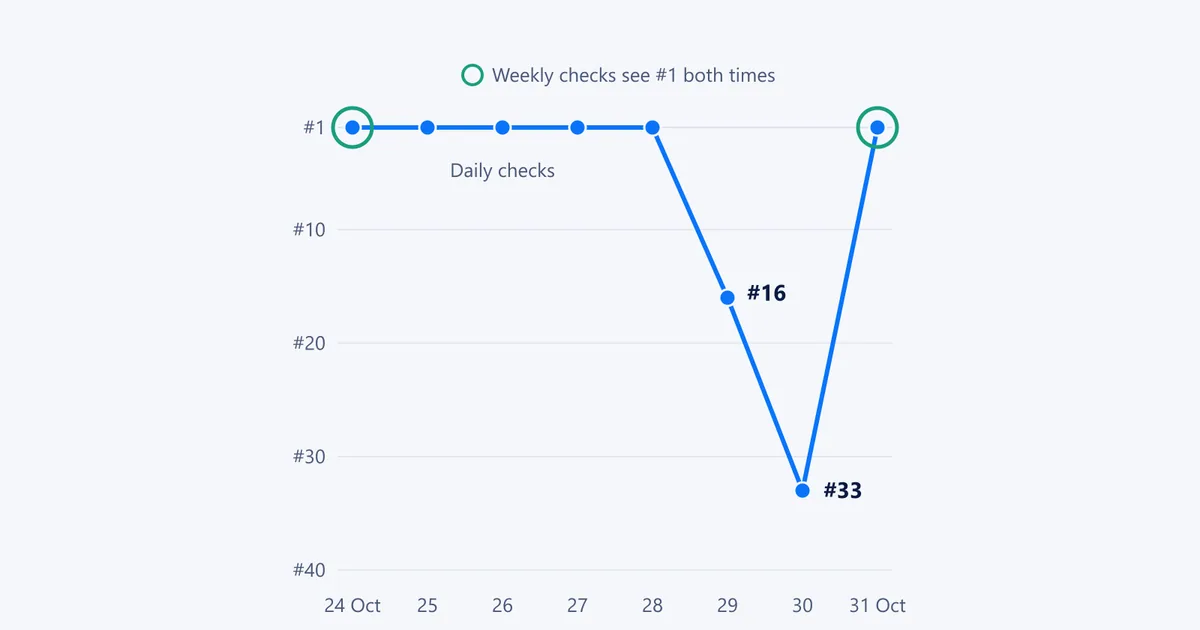
The chart at the top of this article is one of that site's local service keywords in SE Ranking:
| Date | Google position |
|---|---|
| 24 October 2026 | 1 (weekly check) |
| 25 October | 1 |
| 26 October | 1 |
| 27 October | 1 |
| 28 October | 1 |
| 29 October | 16 |
| 30 October | 33 |
| 31 October | 1 (weekly check) |
A weekly tracker checking on the 24th and the 31st would report position 1 both times. In fact the page fell off page one for two days. For a local business that gets calls from that search, those were two days of lost leads, and nobody would have known to look.
Daily data has a catch too. On 30 October, 8 of the 40 keywords that were in the site's top 10 vanished from the top 100 for a single day, and all of them were back on the 31st. That kind of one-day blip is normal SERP volatility (or a quirk of that day's check), not a penalty. Daily tracking shows you more, and that includes more noise.
SE Ranking: daily on every plan
SE Ranking checks positions every day by default, and you can't change that. Its help centre says there is no weekly or every-three-days setting for the main rank tracker. You can also press Recheck Data to run a check whenever you need one. (Its separate Local & Map tracker defaults to weekly.)
- History: positions are kept from the day you set up a project. SE Ranking says project history is available on all plans, back to the setup date.
- Older data: its Competitive Research database goes back to February 2020; Core plans see up to 6 months of it, Growth and above see all of it.
- What it tracks: Google desktop and mobile, Bing, Yahoo and YouTube, down to city or ZIP code, the top 100 results and 35+ SERP features. AI visibility tracking covers ChatGPT, AI Overviews, AI Mode and Gemini.
- Cost: Core is $129 a month with 2,000 keywords checked daily (less if you pay yearly), and there's a 14-day free trial.
See SE Ranking's rank tracker page and its guide to historical data for the current details.
Semrush: daily, but older history becomes weekly
Semrush's Position Tracking updates daily. Semrush says data is generally updated within 24 to 48 hours, and you can't trigger an update manually. See how often Semrush updates Position Tracking.
- History: it starts on the day you create the campaign. Semrush keeps daily positions for 60 days, then one position a week (Wednesday) for 140 weeks, about three years. Deleting a keyword deletes its history. See historical data in Position Tracking.
- Older data: the research database has monthly history back to January 2012 for nine core countries (US, UK, Canada, Australia, France, Italy, Germany, Spain and Brazil), on Guru plans and above. See Semrush historical data.
- What it tracks: Google, Bing and Baidu on desktop, mobile and tablet, down to postal code, plus ChatGPT Search and Google AI Mode with its AI toolkit. SERP features include AI Overviews.
- Cost: the SEO plan starts at $139 a month with 500 tracked keywords. A free account can track 10 keywords, and there's a 7-day trial.
Ahrefs: weekly tracking, deep historical index
Ahrefs' Rank Tracker updates weekly on all plans. Its help centre says weekly is the default with every subscription, and none of its current pages offers a daily option. See how often Rank Tracker updates.
- History: it starts when you add a keyword, and it isn't capped by your plan's history limit. When you add a keyword you can import its older desktop positions from Site Explorer, which is something the other three can't do.
- Older data: Site Explorer's history goes back to May 2015. Lite plans see 6 months of it, Standard 2 years, Advanced 5 years and Enterprise all of it.
- What it tracks: Google only, on desktop and mobile, in 190+ locations down to city and ZIP, with 19 SERP features including AI Overviews. ChatGPT, Perplexity, Gemini, Copilot and AI Mode are covered by a separate tool, Brand Radar.
- Cost: Lite is $129 a month with 750 tracked keywords. See the Rank Tracker page.
Ubersuggest: weekly, cheapest
Ubersuggest's pricing page lists weekly rank tracking on all plans, and its help centre says daily updates are no longer available because of changes in how Google search data is collected. My own projects confirm it: each one shows a weekly update schedule.
- History: Ubersuggest keeps up to three years of ranking history while a project stays active.
- Older data: traffic and keyword volume trends are monthly estimates, with much less history than the other three.
- What it tracks: Google, desktop by default (mobile is an option on paid plans), at country or city level. A separate AI Search Visibility feature checks prompts in ChatGPT, Gemini and Google AI Overviews.
- Cost: $29 to $99 a month, tracking 125 to 300 keywords per project, plus a free account with 25 keywords per project and a one-time lifetime plan. See the Ubersuggest pricing page.
Is Ubersuggest better than Semrush?
For rank tracking, no. Semrush checks positions every day, keeps far more history, tracks more search engines and AI answers, and its research database goes back to 2012. Ubersuggest updates weekly and has much thinner historical data.
Ubersuggest is better on price and simplicity. At $29 a month, or a one-time lifetime fee, it's a sensible choice for a small business or blogger tracking one or two sites who checks rankings once a week anyway. If you report rankings to clients, work on competitive keywords, or need to see what happened during a Google update, Semrush is the better tool.
Which is better, SE Ranking or Semrush?
For rank tracking, SE Ranking gives you more for less: $129 a month buys 2,000 keywords checked daily, against 500 on Semrush's $139 SEO plan. It also tracks Yahoo and YouTube, keeps its daily history from the day you start, and lets you trigger a recheck.
For research, Semrush is ahead. Its database is much bigger (Semrush reports 28.8 billion keywords against SE Ranking's 5.4 billion), its history goes back to 2012 instead of 2020, and SE Ranking's own FAQ admits its search volumes currently trail Semrush's and Ahrefs'.
So: if most of your work is tracking and reporting rankings for many sites, choose SE Ranking. If most of it is keyword and competitor research, choose Semrush. Agencies often use both.
Is Ahrefs or Semrush more accurate?
Neither publishes a head-to-head accuracy test, and it depends on which number you mean.
- Your tracked positions: both check the live Google results. Semrush collects them through third-party SERP providers and records the top 100; Ahrefs fetches Rank Tracker results separately from its Site Explorer data. For the same keyword, location and device, positions should match closely on the same day. The bigger practical difference is frequency: Semrush checks daily, Ahrefs weekly.
- Search volume and traffic estimates: these are models, not measurements, in every tool. Ahrefs found its own volumes "roughly accurate" for about 60% of keywords when compared with Search Console impressions, and its FAQ says traffic estimates can be 20% to 50% off. Semrush describes its volumes as machine-learning estimates built from third-party and clickstream data.
The practical rule: for your own site, trust Google Search Console. Use Ahrefs or Semrush to compare competitors and spot trends, and always compare like with like in one tool rather than mixing numbers from different tools.
How does SE Ranking work?
- Create a project for your website and choose where to track: search engine (Google, Bing, Yahoo or YouTube), country, city or ZIP code, desktop or mobile, and language.
- Add your keywords, optionally in groups, and the competitors you want to compare against.
- Every day it checks the live results, records your position in the top 100, the ranking URL and any SERP features, and keeps a cached copy of each results page so you can see exactly what Google showed.
- Read the reports: position changes, average position, visibility, share of top 10, and competitor movements, all with daily history from the day you started.
Alongside the rank tracker, SE Ranking runs its own crawlers for a research database (competitor keywords, backlinks and traffic estimates back to February 2020), plus site audits, local SEO and AI visibility tools.
Do you need daily rank tracking?
Daily tracking is worth paying for when timing matters:
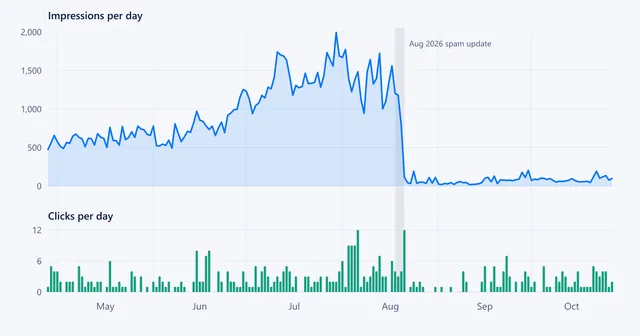
- during a Google core or spam update, to see the day rankings moved;
- after a site migration, redesign or big content change, to catch drops before they cost leads;
- for local businesses and clients who get calls from a handful of keywords;
- when you report to clients who will ask "what happened on Tuesday?".
Weekly is enough for small sites, long-term content projects and keywords you check once a week anyway. Either way, don't react to a single day. As the example above shows, a page can drop out of the top 100 for a day and come straight back. Look for a drop that lasts two or three checks, then confirm it in Search Console before you change anything.
Frequently asked questions
Does Ahrefs track keyword rankings daily?
No. Ahrefs' help centre says Rank Tracker updates weekly by default on all plans, and its current pages don't offer a daily option. You can import older positions for a keyword from Site Explorer when you add it.
How long does Semrush keep ranking history?
Position Tracking keeps daily positions for the last 60 days, then one weekly position (Wednesday) for 140 weeks, about three years. History starts on the day you create the campaign, and deleting a keyword deletes its history.
Does Ubersuggest still offer daily rank tracking?
No. Ubersuggest's pricing page lists weekly rank tracking on all plans, and its help centre says daily updates are no longer available because of changes in how Google search data is collected.
Can a rank tracker show rankings from before I started tracking?
A rank tracker records positions from the day you add a keyword. For earlier data, use the tool's research database: Semrush's goes back to January 2012, Ahrefs' to May 2015 and SE Ranking's to February 2020, depending on your plan. Ahrefs can import that history into Rank Tracker.
Share
X (opens in a new tab)LinkedIn (opens in a new tab)WhatsApp (opens in a new tab)Akif Qureshi has worked in SEO for more than two years, auditing sites, planning content and tracking how Google updates change real traffic. He started SERP Times to report search changes clearly and to say exactly what site owners should do about them.
Certifications
- Google Analytics (Google)
- Google Ads Search (Google)
- HubSpot
- Digital Vidya
- DSIM
- Internship Studio