
MarketingGuide
How to Advertise on ChatGPT: Ads Now Open in the US
Any US business can now buy ChatGPT ads in OpenAI Ads Manager, starting at $25 a day. Here's who sees them, what you can advertise, how to set up and target a US campaign, and how to measure it.

By Akif Qureshi
Published 11 min read
On this page
Here's how to advertise on ChatGPT in the US: sign up for OpenAI Ads Manager at ads.openai.com, add your business details and a credit card, then build a campaign whose ads appear below relevant answers for people on ChatGPT's Free and Go plans.
The US was the first market for ChatGPT ads. Testing started here on February 9, 2026, self-serve buying opened to US advertisers of all sizes in May, and OpenAI now says more than 100,000 advertisers have run campaigns. This guide covers who sees the ads, what you can and can't promote in the US, a first campaign step by step, US targeting, costs and measurement.
Key takeaways
What are ChatGPT ads and who sees them?
ChatGPT ads are paid placements chosen using the context of the current conversation. According to OpenAI's Ads in ChatGPT help page, people see one ad unit below a response. Each ad shows the advertiser's name and logo, a title, a short description, one or more images and a link.
Who sees them:
- Logged-in adults on the Free and Go plans. Go is the low-cost plan OpenAI brought to the US in January 2026.
- Logged-out users, who only see ads "appropriate for all audiences."
- Not paid Plus, Pro, Business, Enterprise or Edu accounts, accounts OpenAI identifies as under 18 (from account information and age prediction), or Temporary Chats.
Free users can switch to an Ads-Free mode in exchange for fewer messages and no access to some tools, such as image generation. In the US, ads can also be personalized: if a user allows it, their past chats and memory can inform which ads they see.
OpenAI's October 21 announcement repeats its core promises: conversations stay private from advertisers, OpenAI doesn't sell customer data, and "advertising does not influence the answers ChatGPT provides." Ads aren't shown next to conversations about personal health, mental health or politics.
ChatGPT ads in the US: the timeline
| Date (2026) | What happened |
|---|---|
| January 16 | OpenAI says it will test ads in the US, alongside the US launch of ChatGPT Go |
| February 9 | Ad testing starts in the US for logged-in adults on Free and Go |
| May 5 | A beta self-serve Ads Manager opens to US advertisers of all sizes, as Axios reported |
| August 31 | OpenAI says ChatGPT Ads passed a $1 billion annualized revenue run rate in under 200 days |
| October 5 | A visual ad format shown during image generation is announced, to be tested in the US |
| October 21 | Ads reach 89 countries; over 100,000 advertisers have run campaigns |
| October 26 | The multi-image ad format opens as an open beta |
| October 30 | Creative enhancements switch on by default |
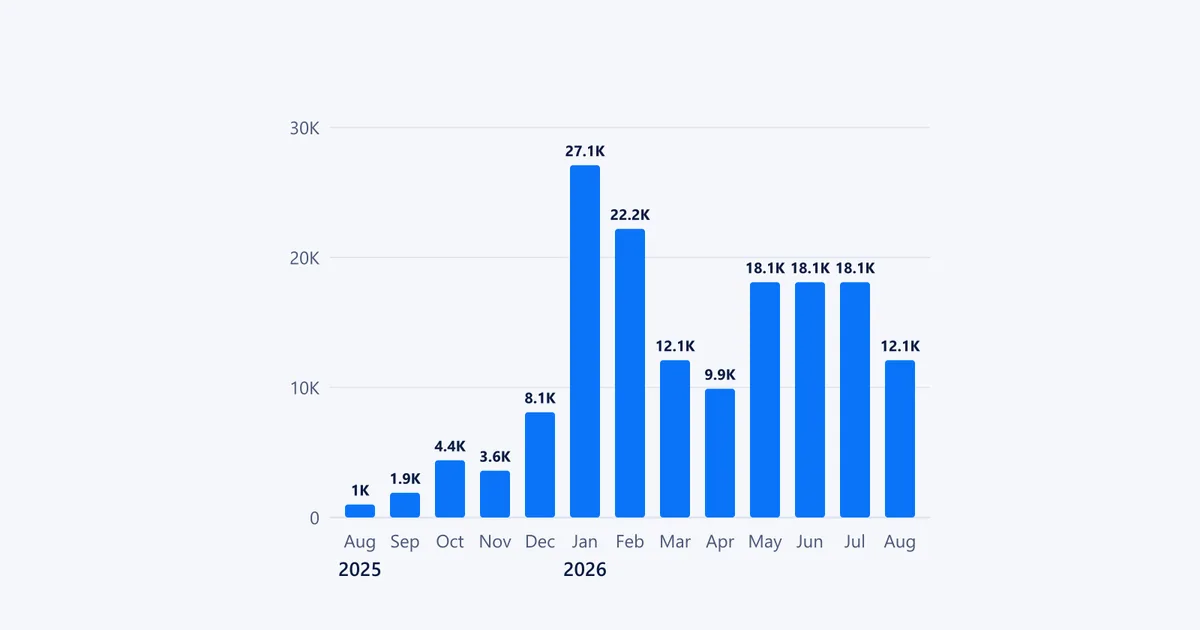
The January announcement is what most US marketers noticed: monthly US searches for "chatgpt ads" jumped from 8,100 in December 2025 to 27,100 in January, according to Ubersuggest (US data, accessed November 1, 2026), and have stayed above 9,000 a month since.
Who can advertise from the US, and what are the rules?
OpenAI's Ads Manager availability page lists the United States (and, separately, Puerto Rico) as available for self-service. Know these account rules before you sign up:
- The paying business must be based in the US. The legal entity that advertises and is billed has to be in an available country.
- Some settings are permanent. Country, currency and time zone can't be changed after you create the account, so pick USD and the time zone you report in, such as Eastern Time.
- Target the US explicitly. OpenAI says that to target only the US you must include the United States in your campaign locations; excluding other countries isn't enough.
What US businesses can and can't advertise
OpenAI's ad policies (updated September 10, 2026) are stricter than Google's or Meta's in places, and some categories are open only in the US:
- Financial services: approved advertisers can run ads for credit cards, mortgages, auto and personal loans, insurance, deposit accounts, brokerages, payment services and similar products, case by case. Proof of licensure may be required. Credit repair, debt settlement and bullion are banned, and financial services ads outside the US are generally prohibited.
- Health services: dental services, dietary supplements, health insurance, hospitals and urgent care, vision care, consumer medical devices, medical testing and minimally invasive cosmetic procedures can be approved case by case, in the US only.
- Legal services: allowed in the US only, and only if the advertiser is licensed to practice law where the ad is shown.
- Not allowed anywhere: political ads, gambling (including sports betting and lotteries), alcohol and tobacco (including vaping), and cannabis or THC products.
So a dental practice in Dallas or a mortgage broker in Denver can apply, but a sports betting app can't.
How to advertise on ChatGPT, step by step
These steps follow OpenAI's setup and campaign creation guides.
- Sign up at ads.openai.com with your OpenAI login. You can enter your website URL so Ads Manager drafts a first ad and campaign, or skip that step.
- Enter your account details: advertiser (brand) name, legal name, country (United States), USD and your time zone.
- Set up billing: a billing profile and a credit card. A temporary authorization hold on the card isn't an ad charge.
- Complete verification, add your logo and invite your team as Admin, Member or Viewer. New accounts can only advertise in their home country until identity verification is approved and they've reached a required level of spend.
- Create a campaign (Create → Create campaign): choose an objective, a budget and your locations.
- Create ad groups, each built around one product, service or customer need, with a maximum bid and context hints.
- Create ads: several titles and descriptions per offer, an image, and the most relevant landing page (not your home page) with UTM tags.
- Submit and monitor. Ads go live after review if billing and campaign settings allow delivery. If an ad shows "Not serving," hover over the status to see why.
How targeting works in the US
There are no keywords to bid on. Instead you combine:
- Locations. Besides countries, you can target "states or regions, cities, markets, and postal codes where available," so an HVAC company in Phoenix can stick to its service area and a regional bank to the states it's licensed in. Campaigns built from a product feed are country-level only for now.
- Platforms. Android app, Android web, iOS app, iOS web or desktop web.
- Custom audiences. Upload your own customer list; you need at least 25,000 matched users to target one (OpenAI recommends 100,000 or more). Smaller lists work only as exclusions.
- Context hints. Short descriptions of the conversations, topics or needs where your ad helps. OpenAI says they "are not exact-match keywords." Write one idea per hint: "a small bakery owner in Chicago looking for simple payroll software" says far more than "payroll software."
How much do ChatGPT ads cost in the US?
OpenAI doesn't publish prices or benchmarks. You pay according to your objective:
- Views (CPM): per 1,000 impressions.
- Clicks (CPC): per valid click.
- Conversions: optimized toward a conversion event but billed per click or per 1,000 impressions, never per conversion.
You set a maximum bid per ad group, and ads compete in what OpenAI's basics guide calls a "relevance-weighted, second-price auction." OpenAI suggests starting click campaigns at a maximum CPC of $3 to $5.
Budget rules (as of November 1, 2026):
- The minimum daily budget for a USD account is $25 per campaign, about $750 over 30 days.
- A daily budget is an average over a Sunday-to-Saturday week in your account's time zone. One day can spend up to twice the amount, and a week up to seven times it.
- Self-serve accounts pay by card: you're charged each time unpaid spend reaches your account's payment threshold, and again for any balance at the end of the month. Thresholds rise automatically as you build a payment history.
What ad formats can you use?
When you create an ad, you choose Single image or Multiple images. The multi-image format, an open beta since October 26, uses 4 to 6 square images that all link to one URL, with "Learn more" as the only button. OpenAI's limits:
- Title: 16 to 24 characters recommended, 50 maximum.
- Description: 32 to 48 characters recommended, 100 maximum.
- Image: square PNG or JPG, no larger than 1,200 × 1,200 pixels.
Three more options matter for US advertisers:
- Shopify. OpenAI's Shopify integration is "currently available to all Shopify customers in the US," so a Shopify store shipping across the US can build ads from its catalog.
- Product feeds (beta) let any retailer create campaigns from a catalog, with prices and ratings in the ads.
- Image-generation ads. On October 5, OpenAI announced a visual format shown while people create images, with testing in the US "with an initial group of advertisers." You can't buy it in Ads Manager yet.
Landing pages must load and must not block OpenAI's crawlers, OAI-AdsBot and OAI-SearchBot. Our robots.txt and sitemap checker shows whether yours does.
Creative enhancements are on by default
According to OpenAI's creative enhancements help page, the feature switched on for new and existing campaigns on October 30, 2026. Using your ad, your landing page and the conversation, it can rewrite headlines and descriptions, translate your text, resize images and send people to a different page on your site.
There's no preview of every variation. To turn it off, select Manage settings in Ads Manager, where you can set an account default and override it per campaign. With Black Friday on November 27 and Cyber Monday on November 30, check this now: if every click must reach one sale page or lead form, switch enhancements off for that campaign, and keep holiday prices current on every page they might pick.
How do you measure ChatGPT ad results?
Ads Manager reports impressions, clicks, spend, CTR, average CPC, average CPM and, once measurement is set up, conversions. Impressions, clicks and CTR refresh about every 15 minutes; spend can lag by 7 to 8 hours.
To track beyond Ads Manager:
- UTM tags on every destination URL make ChatGPT traffic visible in GA4. Our UTM builder creates them.
- OpenAI Pixel and Conversions API. OpenAI's conversion measurement guide explains that each ad click adds a reference called
opprefto your landing page URL, which the Pixel stores in a first-party cookie. Keepopprefthrough redirects, and send the same event ID through both so duplicates are removed. - A GA4 connection is in beta; ask your OpenAI account manager for access.
Ads Manager and GA4 will never show the same totals, because they count and attribute differently; our guide to the difference between Search Console and Google Analytics explains why tools disagree.
ChatGPT ads vs Google AI Mode ads vs Meta ads
Google also sells ads inside AI answers in the US; our guide to how Google AI Mode ads work covers them in detail.
| ChatGPT ads | Google AI Mode ads | Meta ads | |
|---|---|---|---|
| Where they appear | Below a ChatGPT answer; a US test during image generation | Within or alongside AI Mode answers, labeled "Sponsored" | Feeds, Stories, Reels and other placements in Meta's apps |
| What decides who sees them | The conversation, your context hints, location, platform and audiences | The search and the AI answer, matched to your keywords, feeds and campaign targeting | The person: location, age, interests, behavior and audiences |
| How you buy | A separate OpenAI Ads Manager account | Your existing Google Ads campaigns | Meta Ads Manager |
| Keyword control | None; context hints aren't keywords | Broad match and AI Max match contextually; exact and phrase only for direct commercial searches | Not keyword-based |
Google captures people who type what they want, Meta reaches people before they're looking, and ChatGPT reaches them while they compare options.
Should your business try ChatGPT ads?
ChatGPT ads suit categories where people ask ChatGPT to help them choose: software, online courses, travel, home services, and products with clear specs, especially if you already track leads or sales. They're a harder fit if you sell in a restricted category, need exact keyword control (Google Search still gives you that), or can't spare about $750 a month for a fair test.
Run a small, clean test first:
- Start one Clicks campaign with the United States explicitly included, or just the states, cities or ZIP codes you serve.
- Create two or three ad groups for different customer needs, with three to five ads each and several distinct titles and descriptions per offer.
- Set a daily budget at or just above $25, remembering one day can spend up to $50.
- Install the Pixel, add UTM tags and decide on creative enhancements before launch.
- After a few weeks, compare cost per lead or sale with your Google and Meta campaigns in GA4, using the same attribution model.
If the numbers hold up, raise the budget gradually or move to the Conversions objective. Paid channels work best alongside organic growth; our guide on how to increase website traffic covers the free side.
Frequently asked questions
Can any US business advertise on ChatGPT?
Yes, if it's a legitimate US business whose product is allowed under OpenAI's ad policies. OpenAI's Ads Manager availability page lists the United States as available for self-service, and the legal entity that advertises and is billed must be based there. Sign up at ads.openai.com. Financial, health and legal services advertisers are approved case by case, and some categories, such as gambling, aren't allowed at all.
How much do ChatGPT ads cost in the US?
There's no rate card. You set a maximum bid and compete in a relevance-weighted, second-price auction, paying per 1,000 impressions or per valid click. The minimum daily budget for a USD account is $25 per campaign (as of November 1, 2026), and OpenAI suggests starting click campaigns at a maximum CPC of $3 to $5.
Do ads change ChatGPT's answers?
OpenAI says no. Ads are labeled, shown separately from the answer and chosen by separate systems, and OpenAI says advertising does not influence the answers ChatGPT provides. Advertisers get aggregated reporting such as views and clicks, not anyone's conversations.
Who sees ads in ChatGPT in the US?
Logged-in adults on the Free and Go plans, and logged-out users, who only see ads suitable for all audiences. Plus, Pro, Business, Enterprise and Edu accounts don't see ads, and neither do accounts OpenAI identifies as under 18 or Temporary Chats. Free users can also switch to an Ads-Free mode with fewer messages.
Share
X (opens in a new tab)LinkedIn (opens in a new tab)WhatsApp (opens in a new tab)Akif Qureshi has worked in SEO for more than two years, auditing sites, planning content and tracking how Google updates change real traffic. He started SERP Times to report search changes clearly and to say exactly what site owners should do about them.
Certifications
- Google Analytics (Google)
- Google Ads Search (Google)
- HubSpot
- Digital Vidya
- DSIM
- Internship Studio